The Business of Comics for September 14, 2026
Creator question 1: Can you provide some best practices for dealing with unwarranted accusations? This is in response to last week’s story about the Ed Brubaker lawsuit and my comment that you might face attacks on your reputation even if you didn’t do anything wrong.
Now before I answer this question, keep in mind that this isn’t legal advice, it’s more interpersonal observations. And it’s not really about comics. It’s more about life, which isn’t really what this channel is about. Finally, what I’m about to say isn’t original. It's paraphrased from Sun Tzu who allegedly said something like “do not rely on the enemy not coming. Rather prepare for their arrival by making your position unassailable.”
What does this look like in the reality of the 21st Century?
First, assume accusations will come with success. The more you have in terms of money, status, and reputation, the more you will attract negative attention. That’s a cost of doing business.
Second, build defenses before you need them. That could be making sure you have supporters, attorneys, PR people, or even accountants if the accusations are coming from tax authorities, because nobody wants that.
Third, have receipts. The more justifications and proof that you have for your words and actions, the better off you will be if accusations come back at you.
Fourth, increase the cost of attacking you. People are generally risk-averse. If they know it’s going to cost a lot of time, money, energy, reputation, or stress to come after you the less likely it is that they will do it.
Fifth, reduce the benefits of attacking you. Yes, some people are trolls just for the love of the game, but most human actions are self-interested. If there’s nothing to gain by coming after you, most people won’t bother.
Finally, understand that there are levels to this game. A lawsuit is different from a DMCA takedown notice which is different from an accusation on TikTok. Some accusations are not worth addressing. Others, just prove that you have people’s attention.
Creator Question 2. To what extent do you account for the money Disney put into the MCU when understanding its valuation? This is in response to the post about Disney’s four billion dollar investment in Marvel, which is now valued at fifty-four billion.
Now, I have not analyzed every 10K and 10Q Disney has released over the past 17 years. I don’t know the total amount they put into development, production, or distribution for all the films and television shows, or how that’s offset by licensing revenue, tax credits, or leveraged debt. I’m also not smart enough to calculate their earnings before interest, taxes, and amortization. Which is a long way of saying I don’t know. But this question is a good example of understanding the difference between gross and net.
Simply speaking, gross revenue is all the money you make from your comic. Net revenue is all the money you make from your comic, minus the money you had to pay to get the book out into the world. For example, let’s say you made $25,000 from a Kickstarter campaign. That’s your gross. Let’s also say you had to pay $15,000 for the artwork, printing, shipping, marketing, crowdfunding fees, and taxes. That means your net is $10,000. This becomes important both when understanding the financial success of your project and for calculating things like royalties and other profits. Paying a royalty of 10% of the gross is very different from paying them 10% of the net. Understanding the difference between gross and net won’t help you understand how much money Bob Iger made with the MCU, but it will help you with the accounting and negotiation process for your own comics.
Creator Question 3: Is an oral agreement sufficient for a comic book contract?
If you’re talking about a freelance work-for-hire agreement, where an artist transfers their intellectual property rights in exchange for a page rate or some other type of compensation, then the answer is no. A transfer of copyright ownership is not valid unless there is a written instrument signed by the owner of the rights being transferred. If you’re talking about a creator-owned agreement, where a creator gives a publisher the exclusive right to publish their comics, then the answer is also no, because the law treats the granting of exclusive rights in the same way they do a transfer. If you are an independent publisher granting non-exclusive distribution rights to your comics and use of your trademarks but not transferring ownership of the IP, then the answer is yes, but I wouldn’t advise it.
If you grant any type of right to your comic with an oral or handshake agreement and there is a dispute, then the actual terms of that agreement will be decided by an arbitrator, a court, or a judge, and only after you’ve spent a considerable amount of money using lawyers to argue on your behalf. The simple rule is clear. If you want to make a deal for your comic, get a contract, no matter what type of deal it is. Not a handshake, not a set of text messages or emails. Get a clear agreement that nails down your rights, revenue, responsibility, and recovery. It can be a lot cheaper than the alternative.
New Format, New Marketing: I recently about Webtoon’s rollout of reader-based AI functions and the need for creators to be careful about what rights they are giving to Webtoon when they post on the platform. Well, a colleague of mine at Webtoon clarified the information I provided in that post. Webtoon is launching AI-based interactive chat functions, but only in the Korean market. Those features are not planned for release in the US. Webtoon is releasing an AI-based auto-translation program in the US, to allow certain creators the ability to translate their comics into different languages without using a human translator.
The translation function creates an opportunity for Webtoon creators to reach new audiences, but keep in mind that if you release a new version of your comic in Spanish, French, or Cantonese, but none of your marketing is translated into any of those languages, or you’re not driving traffic to each language format of your comic from audiences that speak that language, then the amount of benefits that you’ll get from the translated edition will be limited. The amount of time and energy you have to create new marketing and sales funnels for each new language can have a direct impact on the number of new readers you can attract from different territories.
ICON Comes to LA: On Nov. 7th and 8th in Los Angeles, the inaugural ICON Festival of Comic & Narrative Art will be a two-day celebration of original art by some of the most popular and influential comic book artists working in the medium, including Nick Dragotta, Alex Ross, and Dan Panosian. Unlike mainstream comic book conventions, this event will focus on original narrative art and commissions, instead of movie premieres, celebrity autographs, and cosplay.
It is similar to the Orlando Art Expo, which is held every February, and is another example of how comic book artists can supplement their income, since page rates have been infamously flat for the better part of twenty years. It is also a good example of why freelance creators need to negotiate credit in their agreements. Many aspiring comic artists gain A-list status by working on high-profile titles, but if they don’t get credit for their work, then it is harder to translate their craft into big-ticket commissions and lucrative creator-owned projects. Having your name on a book is about more than pride and personal satisfaction, although that’s nice too. It can become a source of revenue years after you stop working on the book.
Have fun.
Gamal
PLEASE NOTE: THIS BLOG POST IS NOT A SUBSTITUTE FOR LEGAL ADVICE. IF YOU HAVE A CONTENT, LICENSING OR INTELLECTUAL PROPERTY ISSUE, DISCUSS IT WITH YOUR LEGAL ADVISOR OR CONTACT C3 FOR A FREE CONSULTATION.
The Business of Comics for September 4, 2026
The MCU Was Not Inevitable: Last week marked 17 years since Disney announced its acquisition of Marvel Entertainment. That deal was valued at roughly $4 billion in 2009, but the investment has grown into a valuation of about 54 billion, a return on investment of more than 3 times its original cost. Now, comic book fans, especially Marvel fans like me, often pretend this outcome was inevitable, but we need to remember that there was a significant amount of doubt about this deal when it was announced. Marvel had licensed out its most valuable film franchises like Spider-Man and the X-Men, and it was unclear if a family-friendly company like Disney could successfully leverage Marvel IP.
Comic book publishers also need to be aware that it is not enough to own IP. You have to do something with it. For example, Matt Watterson owns the classic Calvin and Hobbes comic, but because he decided to never license the media rights, it didn’t grow. It’s also not enough to do just anything with your IP. Universal tried to fast-track their Monster universe with horrible results. All this shows that the success of the MCU required making good deals, exploiting the IP in the right way, and a considerable amount of luck. It’s going to be difficult, if not impossible, for another publisher to replicate success at that scale again.
Streamers Still Want Comics: Netflix has allegedly acquired the media rights to several different comic book titles, varying wildly in genre and publisher. They’ve optioned horror, science-fiction, and young adult titles from publishers like Image, IDW, and Abrams. This makes sense in the current media landscape. Netflix has been interested in comic book franchises for years, signing first look deals with a variety of publishers. Part of the reason they tried to acquire Warner Brothers was the fact that DC would have been a part of that purchase.
All these deals show that Netflix, and the wider streaming entertainment industry still believe comic franchises have long-term value, which is good news for you. Just remember, if you want a seat at that table, you have to own the rights to your comic, you need to build an audience to increase the value for your story, and you need a business model that will help you survive even if Netflix doesn’t call.
Reputation is a Resource: Ed Brubaker, the author behind the Winter Soldier, is being sued for sexual, racial, and religious harassment, discrimination, assault, battery, and defamation in connection to his creator-owned series Criminal being developed by Amazon and MGM. These allegations have not been proven, and it is unclear how they will affect Brubaker’s show or his overall career, but it is the latest example of an issue we discussed at the beginning of the summer with Neal Gaiman, and last week with Warren Ellis.
Creators on all levels need to understand that success in the comic book industry is not a license to be an asshole. There are morals clauses in publishing and media contracts that can blow up a deal even if you are proven innocent. The public relations impact of an allegation can undermine projects you’ve spent years developing. Can unfounded accusations be used as a lawfare tactic to squeeze money out of successful creators? Yes. Can you suffer social backlash even if you aren’t an asshole? Yes. But reputation is a resource in the entertainment business. If you want to work in this industry, you have to protect it the same way you protect your IP.
The Paradox of Comic Book Writing: Two things can be true at the same time. For example, according to Image executive and writer Matt Hawkins, it has never been easier to become a comic book writer. That is objectively true. Comic book writers can now self-publish, get creator-owned deals, and work on freelance projects in traditional and vertical scroll comics at a level unprecedented in the history of comics. But Hawkins also goes on to say that it is harder than ever to make a living as a comic book writer. That is also arguably true. An independent publisher often has to put more money into their company than they get paid out of it for years before it generates a significant profit, if it ever generates a profit. The advances and royalties from creator-owned deals are often not enough to live on, and the related media deals from those comics are either rare or manipulated by dishonest publishers, or both. Freelance writers have to compete with talent from all over the world, and the days of being on one book for over a decade like Chris Claremont are long gone.
Of course, this doesn’t mean that writing comics isn’t worth it. Some comic writers do make a living from their craft, and a even if they don’t, a writer can generate a significant financial return on investment from comics, even if they can’t quit their day job. And creating comics is about more than just making money. It is an artistic endeavor that has creative, emotional, and social benefits that go beyond revenue. As long as you’re not trying to live off money that your comic IP hasn’t generated yet, just keep writing comics.
Have fun.
Gamal
PLEASE NOTE: THIS BLOG POST IS NOT A SUBSTITUTE FOR LEGAL ADVICE. IF YOU HAVE A CONTENT, LICENSING OR INTELLECTUAL PROPERTY ISSUE, DISCUSS IT WITH YOUR LEGAL ADVISOR OR CONTACT C3 FOR A FREE CONSULTATION.
The Business of Comics for August 31, 2026
Fighting Convention Crime: One of the more disturbing stories that came out of last week’s Anime NYC was a report that several comic creators in artist’s alley were robbed of cash, cameras, merchandise, and even signage. Multiple arrests were reportedly made, but this story reminds us of the challenges of in-person sales. Convention distribution can be a great way for creators and publishers to connect with fans, sell their books, and expand their presence in the industry, but there are costs and concerns that go with getting a table. There are several steps creators can take to limit potential theft, but each one has its own potential complications. You can take only digital payments to avoid having your cash stolen, but many cons don’t have a reliable Wi-Fi signal to process payments. You can have a second person behind the table to manage sales and inventory while you charm the crowd, but then you have to pay for them to attend the show and navigate the limited space behind the table with another person. You can limit the amount of product you put on the table so no one walks off with it, but hiding the items you want people to engage with works more for prints and artwork than it does for comics and merch. Ultimately, creators who table in Artist Alley at any con need to balance the goal of attracting overstimulated readers and discouraging potential thieves.
More and More Manga: HarperCollins has announced it is launching a new manga imprint, Kazé, with the initial lineup of titles for both kids and adults. This is the latest chapter in the expansion of manga in the US, with recent manga imprints coming out of Abrams, Dark Horse, and Mad Cave, and the recent news of the Japanese government funding digital manga expansion in the US market. This isn’t a new trend. Manga began its American rise in the late 1900s, and my first job in comics back then was for an anime and manga publisher here in New York. But in the same way a new independent comic book publisher doesn’t have to create superhero comics trying to compete with Marvel and DC, you also don’t have to make manga or manga-style comics just because they are popular. In most cases, you are better off working in the genre and with the art style that you love rather than just trying to make the type of books that everyone else seems to be making. If you love manga, then by all means make the best ones you can and market them to an ever-increasing audience. But there is a niche for almost every art style and genre. The trick is working in the space that you know best.
AI Invades Webtoon: In a recent announcement that reported a second quarter of declining sales and a larger financial loss overall, WEBTOON is also rolling out multiple AI-driven features for readers and creators. These AI features will reportedly include the ability for readers to build stories using the IP of Webtoon creators who opt into the program. Now, if you’ve been watching this channel for any length of time, you know that comic book creators think AI is the best thing ever (they don’t) and that the mainstream media is constantly reporting about how AI is so helpful to businesses that are losing money (it’s not). But if you are a comic creator with content on Webtoon, or any other digital platform using generative AI, make sure you understand what readers and Webtoon can do with your comics before you move forward, and discuss the ToS with your attorney if you have concerns. You don’t want to wake up one day and find that you gave permission to Webtoon or trolls to infringe on your comics.
Life, Death, and Comics: Roger McKenzie passed away on August 21. He had been dealing with heart failure for several months and died peacefully while in hospice care. McKenzie was known for his work on Daredevil, Ghost Rider, and Captain America, and he was the creator credited with the idea of having Steve Rodgers run for president, which sounds like a really good idea right about now. McKenzie’s death comes at the same time as other high-profile deaths in the entertainment world, including Dolly Parton and Tim Curry. It is in moments like these when I try to remind comic creators of the importance of estate planning. The IP you create, and the revenue streams you develop, may last long after you are gone, so if you want your work to benefit your friends and family, then it is important to have either a will or a trust created for your comic book business. My parents passed away earlier this year, also to heart failure, so I’ll give you some extra tips that I am learning in the process of managing their estate. First, it is not enough to create a will, you have to update it on a periodic basis as your situation changes. If you make your will when you have one comic and no spouse, it won’t be much help if you die with six long-running franchises, a movie deal, a divorce, and three children. Second, whoever is going to handle your comic book business after you are gone needs the contact information for your accountant and your attorney. They should also have some sort of list of the IP you own, the royalties you have coming in, and the payments you have going out. It will also be helpful if they have a way to access your accounts when you take your fingerprint with you to Valhalla. Planning for your death isn’t comfortable or easy, especially when you’ve got responsibilities and deadlines to meet when you are alive, but if you don’t plan for your estate, the government will probably take most of it, and nobody wants that.
Mastering the Art of Comics: Random House Worlds will publish a new guide for comics creators this fall called Marvel’s Mastering the Art of Comics. The book will cover storytelling, character creation, and pitching stories to publishers. The book appears to be in the spirit of classic books from creators like Stan Lee, Scott McCloud, and Will Eisner as well as recent books by Andy Schmidt, Brian Michael Bendis, and Shelly Bond. It is unclear how much of this book will cover the legal and business aspects of comics, but if you can’t find it in that book, you can still read content like this.
Have fun.
Gamal
PLEASE NOTE: THIS BLOG POST IS NOT A SUBSTITUTE FOR LEGAL ADVICE. IF YOU HAVE A CONTENT, LICENSING OR INTELLECTUAL PROPERTY ISSUE, DISCUSS IT WITH YOUR LEGAL ADVISOR OR CONTACT C3 FOR A FREE CONSULTATION.
The Business of Comics for August 21st, 2026
Japanese Government Boosts Manga: New York City hosted Anime NYC over the weekend, and the event included a batch of new releases in anime, manga, and related categories. One of the more interesting facts, from an overall industry standpoint, is the role of the Japanese government in the growth of this art form. According to ICV2, Japan’s Ministry of Economy, Trade, and Industry recently launched new subsidies worth more than 70 million dollars to encourage the development of overseas digital manga platforms by Japanese publishers and distributors. This is part of a broader effort to triple the value of Japanese entertainment exports by 2033.
When you compare the efforts of Japan to promote manga with similar programs in the United States, you quickly realize that there are no similar programs in the United States. Not only are comics not financially supported by the American government, in certain US cities, states, and digital platforms, comics are actively banned, challenged, and otherwise suppressed. Don’t imagine what the US comic book market would look like if the government diverted some of the bailout money for banks, or the weaponization money of ICE, to support the comic book industry. Because that will only make you angry. But the next time you hear someone talk about how manga is doing so much better than American comics in terms of popularity and sales, just remember there are uneven economics going on at the base level, and give yourself some credit for getting your comics out into the world in spite of the challenges you face.
Can Ellis Make a Comeback: Warren Ellis has been a major name in comics since the late 1900s. He was most well-known for his work with Marvel, DC, and Image. Ellis lost all of his deals in 2022, when more than sixty women accused him of predatory sexual behavior. Four years later, Image Comics has announced that it will once again publish creator-owned titles by Ellis, which has prompted a range of responses from the professional comic book community and readers. It is unclear if Ellis still has the cultural cachet he once did, and it's possible that the decision by Image Comics will generate more backlash than sales, but this situation highlights a legal issue all creators need to be aware of.
There is a clause in many contracts called the morals clause. In many cases, that clause allows a publisher or studio to drop your project if you are caught up in some crime, scandal, or other negative public relations event. So the lessons for comic creators are clear. First, don’t be a sexual predator. Second, pay attention to morality clauses in your contract negotiations, whether you are a sexual predator or not. Third, remember that reputation is as important, if not more important, as skill, talent, or the ability to sell comics. Finally, and this is worth repeating, don’t be a sexual predator.
Paying and Performing in Portions: When you are a comic book publisher, hiring an artist in another city, or country involves risk if you pay the entire page rate up front. There is very little stopping them from taking your money and ghosting you, because in many cases it will cost you more in legal fees, collections, and stress to get your money back, if you can get it back at all. When you are a comic book creator, taking a freelance job from a publisher involves risk if you produce all the pages up front. Some publishers pay late, some publishers don’t pay at all, and the more time you spend chasing payments and worrying about payments, the less time you have to actually make comics.
One solution that works for both sides is something I refer to as the tennis method. Basically, the publisher gives a portion of the money when the contract is signed, and the creator delivers a portion of the pages. The publisher then pays more money, and the creator delivers another batch of pages. This continues until the full payment is made and all the pages are delivered. In this process, no one is overexposed, since payments or performance can end whenever the other side disappears. Both sides are also incentivized to perform, because the publisher doesn’t want half a book and the artist wants to keep getting paid. The tennis method is not a guarantee for either side, but it does reduce the risk of being a comic book professional, which is all we can really ask for in this business.
Marketing in Four “Easy” Steps: How do you market a comic book? This is a common question for creators and publishers at all levels, but especially for writers and artists more interested in the creative process than building a business. When I work with clients, we break marketing into four stages.
The first step is to figure out who the ideal reader is for your comic. You find your ideal reader by looking at your characters and your script. Every story in every medium can identify its ideal reader based on demographics, psychographics, generation, genre, and format. Once you know the type of person who is most likely to read your comic, you go out into the world and find out where those types of people already hang out. It could be online or offline, but in most cases it’s a combination of both. After you find your potential readers, the next step is to connect and engage with them on a consistent basis over time. You can’t market a comic or anything else in a single weekend, in a month, or even in a year. This is why even established blockbuster franchises start marketing the movie even before they start filming it. Only after you’ve established a connection with your readers do you ever start pushing them to take an action, whether that’s joining your newsletter, backing your Kickstarter, or otherwise buying your comic.
Marketing a comic isn’t quick, or easy, but if you don’t spend any time marketing your work, people might not spend any time reading your work.
If you have a question, comment, criticism, or joke related to The Business of Comics, please leave a comment.
If you are working on a deal for your comic, or if you need ongoing legal support for your comic book business, please contact me for a free consultation.
Have fun.
Gamal
PLEASE NOTE: THIS BLOG POST IS NOT A SUBSTITUTE FOR LEGAL ADVICE. IF YOU HAVE A CONTENT, LICENSING OR INTELLECTUAL PROPERTY ISSUE, DISCUSS IT WITH YOUR LEGAL ADVISOR OR CONTACT C3 FOR A FREE CONSULTATION.
The Business of Comics for August 14th, 2026
AI Detection Tools Are Coming: The AI apocalypse recently took a new turn in a way that might help creators. Anthropic announced that it is adding a function that will watermark all AI-generated text and images, beginning in August. This move was forced on Anthropic by new regulations from countries like the United Kingdom and US states like California. Other AI platforms are also planning to add watermarks to comply with these new laws.
This move could reduce the uncertainty surrounding comic book scripts and artwork generated by AI, but this may not be the Infinity Gauntlet that will erase AI from comics completely. It can be a powerful tool for creators and publishers trying to prevent AI from tainting their comics. However, those who want to publish AI work won’t bother using this system. Also, it will probably still be possible for someone to retype or trace AI-generated content to avoid the watermark. Finally, it is unclear how easy it will be for retailers and readers to see this watermark in comics, especially if they buy the print version. But given the lack of copyright protection granted to AI comics, the risk of losing publishing and movie deals when AI usage is alleged, and the general negative image surrounding AI comics, the addition of the watermark is another setback for the use of this technology in the industry.
Dangers of Distribution: There have been several developments in comic book distribution since San Diego Comic Con ended. Diamond finally settled their lawsuit against the publishers trying to recover their consignment inventory. Small press initiatives attempting to replace Diamond are gaining traction. Digital comic publishers are rolling out print-on-demand options for direct-to-consumer sales, and some smaller publishers are signing deals to become imprints of larger players.
One concerning trend that I’ve seen over the past few months is the rise of the comic book aggregators, or sub-distributors. Basically, major distributors like Lunar or Simon & Schuster aren’t willing to take on new independent publishers in the same way Diamond did in the past. So, some small publishers who already have an account with a distributor are offering to act as a sub-distributor, inserting themselves into the distribution channel in exchange for a percentage of the sale, and in some cases, an additional fee. This creates a situation where an indie publisher has to share the cover price of the comic with the retailer, the distributor, and the sub-distributor before they can attempt to cover their own production, printing, and shipping costs.
Considering how tight profit margins are for independent comics, and considering that most sub-distribution contracts that I’ve seen don’t guarantee distribution, independent publishers need to be very clear about what they are getting and what they are giving up, before signing a deal with a sub-distributor. In fact, given the current convoluted state of direct market distribution, this is a good time to take a step back, to determine if your book even needs to be in a comic book shop in the first place.
A New Tax on Adult Comics: Adult or not-safe-for-work comics have always faced challenges in the American market. In the late 1900s, criminal cases against underground comix led to the creation of the Comic Book Legal Defense Fund. Before and after COVID, right-wing fanatics launched persistent attacks on inclusionary comics in schools and libraries. Earlier this year, Stripe and Kickstarter tried and failed to institute economic censorship of adult crowdfunded comics. Now, Mixam, an online print-on-demand service popular with independent comic creators, has added what amounts to a new tax on adult comics. According to the site, their new self-reporting content ratings are gathered to ensure your product takes the smoothest and most efficient supply chain route possible, with content ratings having a potential effect on the speed, cost, and production facility that your order is sent to.
While this sounds like a simple logistical process, some creators point out that charging more money to print comics based on the content of that comic is a form of economic censorship, designed to have a chilling effect on these creators. Now there are several factors that impact the cost of comic book printing. Domestic, regional, and international printers all have different prices. Paper stock and finish also changes the price, as does the size and requested speed of your order. There are even printers who won’t print what they deem to be adult material. The only wrinkle in the Mixam situation is their decision to squeeze more money out of creators instead of simply rejecting the order. Adult comics will continue to face challenges in the domestic culture wars. Creators and publishers who work in this space need to navigate even more hurdles than their mainstream counterparts.
Digital Sharecropping and Comic Book Publishing: Here’s a rant that isn’t about comics, but is very important to comics. Marketing is essential to publishing comics. During the 21st century, online marketing, especially social media marketing, is a major component of that process. It takes the form of crowdfunding posts, promotional videos, or general community engagement. One of the major reasons why social media marketing is prevalent in comics is because it is largely free. Unless you’re paying for ads or an influencer, the only obvious upfront cost is your time. But a creator I follow outside of comics recently reminded me of a major pitfall in this process.
There is a social media comedian who built up an audience of several million people across multiple social media channels over a period of ten years. He got so big online that he quit his day job to create content full-time. He also got big enough to attract haters and trolls. Over the summer, they were able to get half of his social media accounts suspended or closed, costing him half of his audience and even more of his revenue. This is an example of what is known as digital sharecropping. It takes its name from a sublimated form of slavery after the Civil War and refers to the process of building a business on a platform that you do not own or control. The fallacy in social media is that you can have the attention of millions of fans or followers. The reality is that YouTube, TikTok, and Instagram have those people’s attention. They allow you to access those people, and they can cut you off from all of them any time they want, for any reason or no reason at all. If all your connections to your colleagues, fans, and readers come from social media, then your business is on very shaky ground.
The solution that I often suggest to my clients is working as hard as possible to move people off social media and onto your mailing list. Once a person gives you their email address, either in a crowdfunding campaign or because they joined your newsletter, it doesn’t matter what social media does or doesn’t give you access to. You will still have a direct connection to your community. It requires more effort and more money, but no one wants to wake up one day to find their entire comic book business has been crippled by an algorithm or a troll.
Digital Delays: While other forms of narrative entertainment have expanded into digital distribution at an exponential rate, comics are still primarily a print medium. Digital comics threatened to be the next big thing fifteen years ago, but Comixology collapsed after being folded into Amazon’s Kindle App, and Webtoon has lost more than 60% of its share value since its IPO in 2024. New players are still trying to build this side of the business, as both longstanding comics publishers and upstart digital retailers have carved out new approaches to producing, selling, and reaching an audience for online comics, but this is still a very difficult business from both a revenue and a reader perspective.
According to Publisher’s Weekly, digital comic book sales only account for 5-10% of total revenue for any publisher, and readers from Gen X, Millennials, Gen Z, and Gen Alpha all display a preference for print over digital for different demographic reasons. Independent publishers definitely get greater access to potential readers through digital platforms, and 10% additional revenue is not insignificant. The solution might be to leverage digital distribution as an enhanced marketing strategy and put the bulk of your sales efforts into print until digital comics become more profitable, if they ever become more profitable.
If you have a question, comment, criticism, or joke related to The Business of Comics, please leave a comment.
If you are working on a deal for your comic, or if you need ongoing legal support for your comic book business, please contact me for a free consultation.
Have fun.
Gamal
PLEASE NOTE: THIS BLOG POST IS NOT A SUBSTITUTE FOR LEGAL ADVICE. IF YOU HAVE A CONTENT, LICENSING OR INTELLECTUAL PROPERTY ISSUE, DISCUSS IT WITH YOUR LEGAL ADVISOR OR CONTACT C3 FOR A FREE CONSULTATION.
The Business of Comics for August 7, 2026
Dark Times at Dark Horse: Dark Horse appears to be dealing with more internal turmoil. Over the past several months, the publisher has parted ways with the founder and CEO, survived a corporate reshuffle within their parent company, closed their mobile app and retail store, absorbed staff unionization, and initiated layoffs. Now, the union is accusing the company of undermining the layoff negotiations by promoting senior editors to management positions. This move could put the in competition with union members instead of working in solidarity with them. Dark Horse appears to have reversed course after this accusation came to light, but it is a reminder that lawfare is often the first choice when trying to resolve a situation. As we discussed in an earlier video, lawfare is the strategic use of legal systems, lawsuits, and procedural maneuvers to intimidate an opponent, damage their reputation, or drain their resources, rather than to genuinely seek a resolution. Creators who might be interested in working with Dark Horse and publishers who have or may have union employees in the future need to monitor the Dark Horse situation to see how all this impacts the comics that they’re trying to publish.
Seduction of the Superhero Fatigue: Hollywood and the entertainment press have struggled through several days of mental gymnastics trying to explain the success of Spider-Man: Brand New Day. The film has generated more than a billion dollars in a week, making it one of the fastest films to reach that point. The reason for all this consternation is that Brand New Day doesn’t fit the narrative of “superhero fatigue” that pundits started predicting in 2009 with the first Iron Man movie (which is hilarious when you consider how successful the genre has been over the past 20 years). But you see, there is a reason mainstream outlets constantly reject popularity metrics, sales figures, and other evidence of the pop culture impact of comics. There is a reason why you rarely hear anyone talk about rom com fatigue, sci fi fatigue, YA fatigue, or reality TV fatigue. The reason is that comics have had a social stigma for more than 70 years, and if you want to sell comics, especially to new readers, you’re going to have to find a way to overcome that stigma.
In the 1950’s, a man named Henry Wortham published a book called Seduction of the Innocent, which claimed, without actual proof, that comics were harmful to children, and society as a whole. Wortham gained a platform during the McCarthy era, and because of testimony like his, Congress threatened to ban comics throughout the United States. This led to dozens of publishers closing, the creation of the Comics Code, and the negative perception of comics in America that has persisted ever since. This is why comics were far more diverse in Europe and Asia prior to the 21 century. This is one of the reasons why you’ll see post after post about “superhero fatigue”. It is simply a modern euphemism for the idea that comics in general and superheroes in particular don’t deserve attention. If you are going to attract new readers to your comic, it is not enough to entice them with your story. You have to manage, consciously or subconsciously, their trained perception that the format of your art isn’t worth their time.
Growth at the Kubert School: The County College of Morris has acquired The Joe Kubert School of Cartoon and Graphic Art, Inc. Beginning in Fall 2026, students will have even more opportunities to prepare for a career in comics. The Kubert School has been an institution in comic book education for more than 50 years, and the merger with a larger school could mean more resources and opportunities for students. Attending a comic book school like Kubert can provide an aspiring comic book creator a streamlined education and industry connections that can evolve over an entire career, but keep in mind that a degree in comics studies has never been required to be a professional in the industry, and the tuition you have to repay, could make it harder to have a career in comics when you get out.
Copyright Control: Here’s a Creator Question: Does having a copyright for a comic mean you control the comic? Owning the copyright to your comic is an important component of control, but it is only the first step out of four. As soon as you create, or pay for someone else to create, an element of the comic, whether it is the script, the character designs, or the final pages, you have a copyright in that comic. But the best way to prove you have a copyright is to register it with the copyright office. Please do not mail the comic to yourself, that is not a thing. After that, you then have to enforce your copyright against anyone who might infringe on it. As we said last week, if you don’t enforce your rights, they aren’t worth much. Finally, you have to ensure that you don’t inadvertently give away your control to a publisher, studio, or other creator in a contract without being compensated for those rights. Creation, registration, enforcement, and negotiation are the four pillars that will help you maintain control of your comics. The more of them that you don’t have, the weaker your control will be.
How Much Marvel Was Enough: Sony Pictures may be taking a victory lap with the success of Spider-Man: Brand New Day, but one financial outlet thinks they should regret a decision they made about the character thirty years ago. In 1998, Marvel was trying to emerge from bankruptcy. One of the things they were trying to sell was the film rights to their IP. Sony grabbed the film rights for Spider-Man and all his related characters for ten million dollars, but Marvel allegedly also offered them all the Marvel characters (except for the X-Men and Fantastic Four) for twenty-five million dollars. Sony decided the rest of the Marvel IP wasn’t worth it, and the rest is history. The Spider-Man live-action and animated films have made over 11 billion dollars over 11 films, but the MCU has gone on to make 33 billion dollars over 38 films. This isn’t to say that Sony would have made the exact same movies or had an equal level of success. In an alternate timeline, they could have made 38 movies of the same quality and success as Kraven the Hunter, and nobody wants that. But this story does highlight the difficulty entertainment businesses have in predicting the future. In 1997, I had a boss who told me that no one would ever watch video on their computer or their phone. That was wrong. You’re doing it now. In 2022, when I was working at Marvel, I had an executive tell me that we couldn’t have three successful movies in a row. Also wrong. The point is not that Sony should have bought Marvel, or that the success of the Spider-Man films should be downplayed. The point is that you can’t predict the future as a creator, so don’t waste time worrying about every opportunity or succumbing to decision paralysis. Just make the best story you can and get it out to as many people as possible. The timeline will take care of everything else.
If you have a question, comment, criticism, or joke related to The Business of Comics, please leave a comment.
If you are working on a deal for your comic, or if you need ongoing legal support for your comic book business, please contact me for a free consultation.
Have fun.
Gamal
PLEASE NOTE: THIS BLOG POST IS NOT A SUBSTITUTE FOR LEGAL ADVICE. IF YOU HAVE A CONTENT, LICENSING OR INTELLECTUAL PROPERTY ISSUE, DISCUSS IT WITH YOUR LEGAL ADVISOR OR CONTACT C3 FOR A FREE CONSULTATION.
The Business of Comics Blog for July 28th, 2026
AI Kills a Book-to-Movie Deal: There are a lot of reasons why comic book creators are against the use of AI in the creation of their art. Hollywood recently added one more rationale to avoid the technology. It appears that a book-to-movie deal was recently killed because AI was allegedly used to create the underlying manuscript. Now the studio didn’t walk away from the project because they have some moral stance against AI. The choice was made for purely practical reasons. You see, when any media is made from a pre-existing book, there needs to be a what is known as a clear chain of title before the project can move forward. Chain of title is a legal term that sounds imposing, but it really boils down to the idea that you can’t sell what you don’t own. In this case, ownership of the story means that you have the copyright for the book. But the copyright office has made it clear that AI-generated books aren't protected by copyright in the same way as other books. If there is no copyright, there is no clear chain of title. If there’s no chain of title, the studio will not make that movie. This move mirrors the stance that many of my publisher clients take with creator-owned books, so if you want to use AI to make your comics, you’re going to have to accept the idea that publishers probably won’t take them, and film and television based on that story might never be made.
Artists Speak Out Against Silver Sprocket: Right before San Diego Comic Con, a group of comic creators released an open letter about the indie publisher Silver Sprocket. The letter alleges systemic accounting problems, financial miscommunications, and a general lack of professionalism, in addition to late or missing royalty payments. It isn’t unusual for comic creators to have complaints about their publisher, depending on the publisher, but this case highlights two distinct issues. First, the basis of these accusations is a textbook example of what is known in the entertainment industry as Hollywood accounting. Hollywood accounting is what a studio or publisher does to manipulate the financial records of a particular project to ensure that the creative people involved receive as little as possible, if they receive anything at all. It is most associated with the film industry, but the principles (if you can call them principles) can and are used in comics, although it is unclear if that’s what's going on in this situation. The other issue is that the creators decided to release an open letter to the industry, rather than go after Silver Sprocket in court. There might be several reasons for this, but one of the persistent problems in the comic book industry is that creators often can’t or won’t pursue court claims against publishers who might have breached their contracts, either for financial or professional reasons. This general lack of enforcement tends to undermine the rights creators fight for in contracts. If you’re not willing or able to enforce the rights you have in a contract,
Does Synergy Lead to Restirictions?: Here’s a creator question: Will Marvel Comics’s move to LA and increased synergy with Marvel Studios lead to more restrictive stories?
I’m not really sure what you mean by restrictive, since Marvel has always had creative limitations on what goes on in the Marvel Universe even before the Comics Code, but if you mean that the comics won’t stray far from the storylines in the film and TV shows, I don’t think that will be the case. From my perspective, Marvel Comics serves three overall functions for Disney: First, they are an R&D arm for the studios. They can produce stories at lower costs, and with faster direct feedback than a TV pilot or a test screening. Second, they serve a marketing function to promote the IP to the core audience on an ongoing basis. Finally, they need to generate some money to pull their weight for the Mouse. I don’t think any of those core functions are going to change when the comics division is in the same building as the studio executives, although the turnaround time for coordinating between the studios, licensing, and comics might be faster. The bottom line is that the freelance talent making the comics will still be spread around the world, so if the functions of the company remain the same, and the overall talent pool is the same, you might not notice a difference in the comics you pick up.
What is IP?: There were several professional panels at San Diego Comic Con this year discussing how to develop, pitch, and protect IP. Unfortunately, none of the panels I attended explained what IP was or why it needs to be protected. At the risk of being overly unsophisticated, I think it’s important for comic creators to know what it means when they’re talking about IP. Legally, IP, or intellectual property, focuses on intangible creations of the human intellect. In English, that translates to the ownership of the expression of ideas. So, when you create a comic book, or the elements of a comic book, you are creating intellectual property, specifically, a copyright. When you sell multiple comics, or any other item related to your comics, using a name or image from the story, you are also creating intellectual property, specifically a trademark. The reason that IP is important is that whoever owns the IP controls what happens to it, and is entitled to any money that comes from it. At their core, companies like Viz, Penguin Random House, Marvel, and DC make money because they own or control valuable IP. The basic rule of the game is the more IP you control, the more money you can make. The reason that it is important to understand how to protect your IP is that you can lose ownership and control very easily. You could sign your name to a contract, use a piece of software, or create IP with someone without having clear terms of who owns what. IP is the core of the comic book business. If you’re making it, it helps to understand what to do with it.
Why are you making comics? Last week, I posted a video explaining the impact of signing away your original characters to DC or Marvel as a part of a freelance deal. That post generated a comment that is worth exploring. The comment says “Here’s the thing, if you don’t sign over the rights to your new characters, you better hope that you’re creating a new Spider-Man or Batman, because otherwise your character will just never be used in expanded media.” Now this comment ignores the fact that dozens of films, TV, shows, and video games have been made from independent comics over the past 40 years, but it still raises a valid question at the core of the creator experience. Why exactly are you making comics? Do you want to see the characters and stories you created translated into movies, even if you never get paid for it? If that’s the case, then your best bet is to sign a freelance deal with Marvel and make your comics. There is nothing wrong with that goal if that’s what you want to do. Do you want to own the stories you create, even if your characters are never in a billion-dollar movie, or any movie at all? If that’s the case, then you should be looking for a decent creator-owned deal. There’s no shame in that. Do you want to own both the story you made and the company that produces those stories? Then you need to start an independent publishing company and be prepared to put your own time, money, energy, and resources to get the business off the ground, knowing that it may never get off the ground. The core question isn’t should you or shouldn’t you sign over your characters to a publisher. The real question is what do you want to accomplish as a comic creator, and which deal for which book will give you the best chance to get where you want to go.
If you have a question, comment, criticism, or joke related to The Business of Comics, please leave a comment.
If you are working on a deal for your comic, or if you need ongoing legal support for your comic book business, please contact me for a free consultation.
Have fun.
Gamal
PLEASE NOTE: THIS BLOG POST IS NOT A SUBSTITUTE FOR LEGAL ADVICE. IF YOU HAVE A CONTENT, LICENSING OR INTELLECTUAL PROPERTY ISSUE, DISCUSS IT WITH YOUR LEGAL ADVISOR OR CONTACT C3 FOR A FREE CONSULTATION.
The Business of Comics Blog for July 21st, 2026
No More Marvel in Manhattan: The big news leading into this year’s San Diego Comic Con is the move of Marvel Comics from New York City to Burbank, California, the current headquarters of Marvel Studios and corporate parent, The Walt Disney Company. While this news rippled across mainstream media and the comic book press, it is in line with the increased integration between Feige, the film studios, and publishing that has been in the works since 2023. This physical move will also coincide with a change at the editor-in-chief position and marks a continued shift in comic book publishing from New York to California.
For comic creators, this move can have other ripple effects. Marvel editors and other staff who can’t relocate to the West Coast, might become available if they aren’t allowed to work remotely. If that happens, new editors might join the company to fill those empty slots. That in turn could change the fortunes of some freelance talent, with some creators losing gigs as new editors bring in their preferred people.
As a lifelong New Yorker, the one thing I’m sure that probably won’t change is the central nature of New York City in the Marvel Universe. I’ve been to Burbank. They don’t have enough skyscrapers for Spider-Man to swing on, and I doubt Galactus is going to suddenly descend on Downtown LA.
McFarlane Merges Multiple Revenue Streams: Todd McFarlane, the creator of Spawn, is attempting to combine live selling, art sales, and autograph signings at this year’s San Diego Comic Con. The move is designed to sell rare art before the show even starts, which gives fans who can’t afford San Diego the ability to still buy his pieces. It offers an extra incentive to buyers who can actually attend the show, and it generates increased online content and interest in his work.
McFarlane might be a controversial figure in comics, but this move is, at its core, a higher profile attempt to diversify income as a comic book artist. We’ve discussed before how freelance page rates are not a sustainable form of income for many artists. The artists who supplement their income are turning to retailer variants, direct-to-consumer online stores, in addition to commissions and convention appearances. Many entrepreneurs like Gary Vee are calling live shopping the next great opportunity in the gig economy, and if this project works, we could see more integration between online and convention sales in Artist Alley. Todd McFarlane might not need to seek out new sources of income to make ends meet, but freelance artists might want to consider using his tactics to make more money from their work.
RIP Comix Wellspring?: Comix Wellspring was a popular printer among independent creators and publishers. I say was because the company recently announced that it is temporarily suspending all operations, halting production, and refunding all unfulfilled customer orders due to what it describes as “unforeseen operational challenges”. This comes at a particularly bad time for publishers, since it is the middle of the convention season and only days before San Diego Comic Con.
The closure of Comix Wellspring is also another blow to the distribution pipeline for independent comics, since many publishers are still looking for alternative ways to get their comics to market in the wake of the Diamond bankruptcy. I don’t know how many tables in Artist’s Alley will be empty because creators can’t find an affordable, last-minute printing solution, but hopefully this won’t push anyone out of comics completely, and Comix Wellspring can make an eventual comeback.
Clover Press Goes Creator Owned: Clover Press has announced a new creator-owned imprint, The Fourth Leaf, just in time for the publisher’s appearance at San Diego Comic-Con 2026. The company that made a name for itself with a long string of successful Kickstarter campaigns for licensed comic art books and newspaper comic compilations is now expanding into creator-owned graphic novels.
Clover Press has the infrastructure and understanding of the distribution side of comics, but it isn’t clear what kind of creator-owned publisher they will be. Creator-owned comics deals are often the most ambiguous relationships in the industry, and run the range from very creator-friendly to absolutely abusive. Creators looking for a creator-owned deal with Clover, or any other publisher, should have that contract reviewed and analyzed by an attorney who understands the industry before you sign anything. If only you knew of somebody like that who could negotiate that deal for you…that’s a hint, by the way.
Dark Horse Developments: Dark Horse Comics recently announced new management changes. After parting ways with the founder and CEO, the company will have three heads: one for publishing and business development; one for publishing operations; and one for finance and administration. This move comes in the wake of a corporate reshuffle within their parent company, staff unionization, layoffs, and the closure of its mobile app and retail store.
Dark Horse has a full slate of panels and signings planned for San Diego Comic Con this week, but creator-owned and freelance creators who don’t already have a relationship with the publisher might want to wait until the dust settles to approach this company with a new project.
Indies Come Together for Distribution: A new group called the Indie Comic Alliance has announced a program to distribute independent comics to the direct market. The Alliance plans to offer Independent Publishers reasonable Distribution into retail comic book stores and affordable Printing, Shipping, and Storage while creating a competitive advantage in the direct market by having a destination for customers to find Indie Titles. This is another response to the collapse of Diamond and will likely try to compete with the wave of sub-distributors and aggregators trying to fill that hole in the market.
More than twelve independent publishers have already signed on, but the real question is how many of the 3,000 comic book shops in America will decide to use them, how many orders they can generate on a regular basis, and most importantly, what is the financial breakdown for independent publishers who sign on with them. Distribution can be a complex issue in 2026, so make sure you understand the financial and legal implications of whoever you choose to get your books in the hands of your readers.
The Marvel Method: It’s almost time for another MCU movie, which means it’s also time to re-explain freelance IP creation to comic creators. Almost every time DC or Marvel releases a film, a veteran creator will remind everyone that while they created characters in the film, they don’t own them and they didn’t get paid anywhere near what the movie and secondary revenue streams will generate, if they get paid at all. It happened with the Winter Soldier, it happened with Thanos. There have been major court cases for almost all of the Avengers, and other legal battles over Superman, the X-Men, and other characters. This time it’s William Metzger, one of the antagonists of the film Spider-Man, Brand New Day. Metzger’s creator Joe Casey spoke up about the lack of payment for Metzger, and the fact that he’s still looking for payment for America Chavez, a character he created that played a prominent role in Dr. Strange and the Multiverse of Madness.
This is the modern Marvel Method. The creators and characters may change, but the song remains the same. The characters being used in modern movies were created in the late 1900s, so those creators didn’t have the knowledge or options that you have, so let’s repeat the lesson for everyone who needs to hear it. If you create new characters for Marvel or DC, you will not own them. You will not be paid for them beyond your page rate and a possible royalty or bonus payment. If that is something that does not work for you, do not work freelance in corporate comics, or if you do, do not create new characters for them. Marvel and DC each have thousands of characters. They do not need yours. Use their toys to make their comics and make your page rate. Keep your toys for your own comics.
Classic Characters Create Cash: A recent article asks why the independent and small-press scene in comics seems to be thriving, and yet the Big Two haven’t put out an original character in years? The question itself is disingenuous because a thriving independent industry and original superhero characters are not mutually exclusive, but the question does raise issues that comic creators need to understand. First, independent comics are doing better than they have ever done. Lower production costs, greater access to markets, and streamlined management brought about by digital technology make this the best time to be an independent comic creator, although it still isn’t easy. Second, the Big Two, by and large, do not make new characters. Their freelance talent makes those characters, and these companies have famously financially disincentivized creators from developing original characters. But the issue goes deeper than that. In spite of the fact that Marvel and DC own the majority of comic book shop sales in North America, Marvel and DC are not comic book companies. They are character franchise companies.
If you go to the about us page on Marvel.com, for example, the company describes itself as “one of the world's most prominent character-based entertainment companies, built on a proven library of more than 8,000 characters featured in a variety of media in entertainment, licensing and publishing. Comic book publishing at that level feeds the corporate machine, rather than being a profit center. Consider this: Marvel has licensed two mobile games on the market now that have generated almost three billion dollars over the past 10 years in license fees alone. These are mobile games, not movies, not triple-A video games, not clothing, not toys. Free-to-play mobile games. In that same 10-year period, Marvel’s comic book publishing made them about 1.5 billion in profit. In that kind of business model, I would argue that variations of established characters are just as valuable, if not more than, new characters, because that variety allows the corporation to plug in whichever version of the character works for any given project, or in the case of Lego Batman, all the versions can be thrown in at once. This isn’t to say that new characters are bad, or that corporate comics are without fault, but independent comic book publishers and corporate publishers are playing a different game with different business models. Confusing the two doesn’t make sense, and could be a recipe for disaster.
On Writing Corporate Comics: New writers who pitch stories to Marvel or DC often try to impress editors with a dramatic reimagining of their favorite character. They’ve seen what happened with Dark Knight Returns or what’s happening now with the Absolute Line and they try to pitch a story that “completely changes everything”. According to a recent post by longtime Marvel editor-in-chief Joe Quesada, that is a mistake.
Corporate comic publishers with legacy IP don’t want new writers who are going to subvert a profitable, proven concept. They want you to be able to write something that feels fresh within the construct of who the character is. They need you to prove you can be a consistent, reliable, and expressive storyteller. If you can do that, you might be able to get your foot in the door. Once you’ve established your track record over time, then they might give you the reins to do your Court of Owls, House of X, Absolute Line, or whatever.
Moulin Rouge: The Graphic Novel: Rocketship Entertainment has signed a deal with Moulin Rouge to develop tabletop games, graphic novels, and manga set in and inspired by the famous Parisian cabaret. While it might be unusual for a comic book publisher to negotiate an IP license for what is essentially a building, you have to keep in mind that Moulin Rouge has been the subject of more than a dozen films, a Broadway play, two restaurants, a hotel, and a handful of books about the major characters associated with the space.
While it is unclear if fans of the Moulin Rouge can be found in, or are willing to migrate to, comics and manga, independent publishers, especially ones who are building their companies on licensed IP, can look beyond the current trends of video game and public domain properties, to publish books with little or no competition once the audience is found.
More than Time and Money: Here’s a creator Question: As an artist, if you got 5K per month, how many pages of art could you produce? This question generated more than 250 replies in the Business of Comics Facebook group, but in reality, it has too many unknowns to be answered accurately.
Depending on the complexity of the script, the art style of the artist, the number of approvals you need at each stage, the amount of revisions after approvals, the other commitments of the artist, the length of the project, the dynamic between the editor, artist, and writer, and several other factors, there is no realistic way to know beforehand how many final pages an artist can produce. Now artists often have deadlines, and the amount you’re getting paid can have a real impact on how fast you work, but time and money are just two factors in the equation. If you’re a publisher, or an artist, who makes a deal without considering the other factors, it can easily lead to friction and misunderstandings in the project.
After Shocks for AfterShock: In December of 2022, independent publisher AfterShock filed for bankruptcy along with its sister film production company. In May of this year, the company emerged from bankruptcy with a court-approved plan to pay outstanding debts to creators and vendors. Now, Aftershock has added their titles to the digital distribution platform GlobalComix to re-establish themselves in the market. Hopefully, the post-bankruptcy restructure, court-approved debt repayment plan, and new publishing initiatives can bring compensation to the impacted creators, and AfterShock can begin moving forward. The question is, how long will it take them to pay their debts? Who is going to print, distribute, or market their comics after four years of bankruptcy? What creators are going to be willing to sign their rights to a publisher most recently known for not paying their creators? How will the reversion rights in their contracts change in light of this new chapter of the company? Until the first two questions are answered to your satisfaction, the last two questions might not be worth asking.
If you have a question, comment, criticism, or joke related to The Business of Comics, please leave a comment.
If you are working on a deal for your comic, or if you need ongoing legal support for your comic book business, please contact me for a free consultation.
Have fun.
Gamal
PLEASE NOTE: THIS BLOG POST IS NOT A SUBSTITUTE FOR LEGAL ADVICE. IF YOU HAVE A CONTENT, LICENSING OR INTELLECTUAL PROPERTY ISSUE, DISCUSS IT WITH YOUR LEGAL ADVISOR OR CONTACT C3 FOR A FREE CONSULTATION.
The Business of Comics Podcast for June 15th 2026
Reader Questions:
Rights Recovery: If a company options, buys, develops, shelves, cancels, removes, or otherwise stops using a creator’s show, comic, or creative property for a set amount of time, what path does the creator have to reclaim the rights or at least request formal rights reversion?
This question focuses on the fourth aspect of any contract, which is recovery. Just to recap, most comic book contracts have four parts: the rights, where you determine what is happening with the comic IP, the revenue, where you establish how much the rights are worth and when the money comes in, the responsibility, where you lay out what each side has to do, and the recovery, where you figure out what happens when something goes wrong.
Depending on the type of deal you’re working with, there are several options for a creator to get their rights back.
In a collaboration deal, if one side leaves the project, the other side could have the option to retain all the IP they created.
In a creator-owned deal, there could be a time limit on how long the publisher has to publish the book, and an out-of-print clause that reverts the rights if the book is no longer being sold.
Even freelance creators can have kill fees placed into their contract to guarantee they get paid something if the project falls apart.
The keys to getting your rights back is understanding what the contract says and having the leverage to make sure the right clauses are in your contract.
To Trademark or Not To Trademark: Does it make sense to trademark your comic after you register the copyright?
Registering a copyright and applying for a trademark are related concepts, but they protect different aspects of your IP and need to be treated separately. You can register a copyright on your own, especially with the free guide that I offer to everyone who joins my newsletter, but a trademark requires more money, more effort and more long-term planning.
The basic question you have to ask yourself when you’re thinking about filing a trademark is “what do I plan to do with this story and how long do I plan to work with this title?” Every category of products is treated separately for trademarks, so if you plan to use your mark for comics and posters, and hats, and t-shirts, and toys, then you have to file trademarks for each one. In addition, when you apply for a trademark, you have to prove that every product that you are applying for is actually being sold. For example, you can’t apply for a trademark for your comic in video games and then never make a game. Finally, even if you are successful in registering the trademark, you have to prove that you are still using the mark every six years. So if you’re planning a long-running series like Spawn or Invincible, then it makes sense to register the trademark. If you’re a creator who moves from story to story like Smile and Baby Sitter’s Club, then a trademark makes less sense.
The Cost of Crowdfunding: “How much does it cost to crowdfund a comic?”
This is a good fundamental question. We talk a lot about the revenue opportunities for independent creators in crowdfunding, but it is important to remember that Kickstarter isn’t a magic button you press to get free money. There are three types of costs that a creator has to consider before launching a campaign, fixed costs, variable costs, and hidden costs.
The first and easiest cost to track is the amount you have to pay the crowdfunding platform and the payment processing company. Those are the fixed costs. For example, Kickstarter takes a flat 5% from the total revenue generated from a successful campaign, and the payment processor takes another 3-5%, so your fixed costs there are about ten percent, but that comes from the campaign revenue. You don’t have to pay that money up front.
The variable costs, which are determined by how much you decide to pay for the production of the backer rewards, the distribution costs, the marketing costs, and the labor costs of anyone you decide to pay to support the campaign, might be payable before the campaign launches, and you might have to pay some of those costs regardless of the success of the campaign.
Finally, there are hidden costs that don’t show up on your P&L. These include the time you spend before, during, and after the campaign to make things happen, and the opportunity costs of not using that time and money for something else. Crowdfunding can be a lucrative distribution channel for comic book creators, but it is not an easy business and it is possible to lose money, even if your campaign is successful.
Comic Industry News:
Diversified Career Numbers: BOOM!, DC, Image, and Marvel writer Stephanie Phillips posts a lot of great information for aspiring creators on her TikTok, and a recent post offered a practical breakdown of how to make a living as a comic book writer. We’ve talked on this show several times about how hard it is to make a living just on page rates, but Stephanie only uses that as a base. To that, she adds revenue from convention appearances, signings, revenue from creator-owned IP, and royalties from both freelance and creator-owned projects to round out her income. This diversified approach requires more marketing, more planning, more extroverted behavior, and more overall hustling than sitting in your studio creating comics, but unless page rates suddenly rise to match the cost of living (newsflash: they will not), pulling in revenue from several sides of the industry gives you the best chance to quit your day job.
The Perils of OPM: Comics Beat recently ran a story about the legal troubles Archie Comics is currently facing. The publisher of the classic IP took a loan from an investment company for forty million dollars and signed another IP development deal for eighty million dollars. Then, allegedly, the principals of Archie failed to pay back the loan and signed a conflicting development agreement with Universal. The case is still ongoing, but the lessons for independent comic creators is clear. First, if you take other people’s money for the development of your comics, you have to have a plan to pay than money back, even if your comics don’t sell. Second if you sign an exclusive deal for your IP, you can’t sign another deal for the same IP in the same category unless you want everything to blow up in your face.
The Movable Feast: Oni Press has decided to crowdfund the sixth and final volume of LySandra Vuong’s popular Webtoon Covenant, exclusively in print, despite the fact that the series has 738,000 followers and over 29 million reads on Webtoon. This is an interesting move because it is essentially migrating an audience from a low-revenue platform to a higher one just before the story ends. While the move is unusual, we have seen similar activity in other media recently. The end of the Netflix series Stranger Things, was released in theaters, even though millions of fans consumed all the other episodes on the streaming service. The difference between Stranger Things and Covenant is that the final episode of Stranger Things was available in theaters at the same time as the streaming service. Fans didn’t have to switch media to see the end of the story if they didn’t want to. Covenant fans won’t have that same choice, at least not during the Kickstarter campaign. While this might seem like a big gamble for Oni, it could still payoff, since even if only 1% of Covenant’s 738,000 fans back the campaign, the revenue could still be substantial. Having said that, comic publishers who want to maximize their audience might want to consider expanding the options for readers to get their story, instead of trying to migrate their audience all at once.
Comics Gets New Sales Charts: This week marks the release of new direct market sales charts. These charts are the result of a collaboration between my client Prana: Direct Market Solutions, Manage Comics, and Comic Shop Assistant, and are designed to replace the sales data Diamond provided prior to their bankruptcy. The charts are based on data from 80,000+ consumers and 600+ stores in various markets. The interesting thing here isn’t the results of the chart but the structure of it. Most historical charts pull their results from direct market and point of sales systems, but these new charts also try to incorporate data from comic book readers, not just the shops. Older charts focused on the shops because since direct market comics are non-returnable, the shops were the customers for financial purposes. These new charts have the potential to show not just what the shop owners decided to buy, but what the readers of comics decided to pay for. While this could paint a new picture for comic book sales, creators should keep in mind that it still only tracks trends in the direct market. Sales in bookstores, conventions, crowdfunding, and direct-to-consumer sales are not represented.
Growth of Independent Bookstores: The American Bookseller Association has reported that membership was up 19% in 2025, to 3783 member locations. This indicated a continuing reversal of the pattern of buying books on Amazon or at larger booksellers like Barnes & Noble. It appears that consumers are looking for real-world interaction with the communities that independent retailers create and the curated products that they sell, which mirrors the story we discussed a couple of months ago, where Gen Z expressed a need to interact with the real world, and Gen X and Millennial readers were more interested in physical books than digital copies. This trend might reveal an opportunity for comic creators to find and engage with potential readers more successfully, even if it is on a smaller scale.
The Variant Impact: ICV2 ran a story tracking the monetary impact of variant covers on single-issue sales. This data, which came from a single retailer over a six-month period and tracked over 6,000 different SKUs or stock tracking numbers, revealed that 35-40% of the revenue from new comics came from variant covers. While it’s not a majority of the single-issue revenue, the data suggests that for many titles, variant covers likely make the difference between profit and loss on a title. Now before you go off and commission fifteen variant covers for your comic, keep these things in mind:
First, variant covers are not about your story, they are about the appeal of the artist, your character, and the perceived collector’s market for your comic. These factors can drive up sales if Dave Nakayama or Mark Brooks are doing variants for Batman or X-Men, but it might not have the same impact on your up and coming comic.
Second, these numbers are for direct market sales for one retailer. The sales impact might not apply in the same way to your crowdfunding, conventions, or anywhere outside the direct market.
Finally, variant covers increase your production costs and the amount of copies you have to sell to break even. Before you sign multiple cover artists to your project, figure out the business impact of all that cool art.
Comics for Culture, Not Just Profit: Finally, we need to end this business-oriented show with a discussion of culture and politics. Marjane Satrapi, the author of the award-winning graphic novel Persepolis died earlier this month. That loss sparked renewed interest in the graphic novel, which was a milestone in comics, drawing new attention to the medium, and providing a point of comparison for the literary graphic novels that followed. It has also been one of the most banned and challenged books, especially in the United States. In an ironic twist, the fight against the ban of Persepolis became a graphic novel itself called Wake Now in the Fire. The social, political, and personal impact of Persepolis raises potential concerns for all types of comic creators. The stories you decide to tell in comics, the issues you decide to deal with, or avoid, can impact you and your life far beyond the sales of your comic. I have clients who write under pseudonyms, or form shell companies to protect their personal lives from the backlash created by their work. You don’t need to be an Iranian comic creator to come under fire for your comics. Many of the most banned books in America are comics, and comic creators face harassment and death threats from toxic fans, political extremists, and other opponents of ideas. As a comic creator, remember that you are in the business of art, and art is political, regardless of what simplistic perspectives try to present.
If you have a question, comment, criticism, or joke related to The Business of Comics, please leave a comment.
If you are working on a deal for your comic, or if you need ongoing legal support for your comic book business, please contact me for a free consultation.
Have fun.
Gamal
PLEASE NOTE: THIS BLOG POST IS NOT A SUBSTITUTE FOR LEGAL ADVICE. IF YOU HAVE A CONTENT, LICENSING OR INTELLECTUAL PROPERTY ISSUE, DISCUSS IT WITH YOUR LEGAL ADVISOR OR CONTACT C3 FOR A FREE CONSULTATION.
The Business of Comics for June 1, 2026
Marvel Loses Publisher: One of the big stories in the comics industry around the Memorial Day weekend was the continued changes in the management of Marvel Comics. In the last episode, we talked about the downsizing of the staff at Marvel, and shortly after that, it was announced that Dan Buckley, the longtime publisher of Marvel, would be stepping down in 2027 to be replaced by two Disney executives reporting directly to Kevin Feige. Now while some commentators online have linked this move to the fall in market share Marvel has had over the past year relative to DCs Absolute Line, I think that view ignores the reality of conglomerate comics. Because of the size of these companies and the levels of decision making that have to be worked through, changes at Disney don’t happen quickly. Consider this, Marvel Studios chief Kevin Feige added publishing to his portfolio in 2023, in the aftermath of Bob Chapeck leaving Disney and Ike Perlmutter leaving Marvel. Industry observers have been waiting for Feige to put his imprint on the comics side of the company, but from a financial standpoint, that was a lower priority compared to the film and television aspects of Marvel. If you’re an independent comic book publisher, you have the ability to adjust and react to industry changes and your competition quickly. Companies like Marvel and DC don’t have that luxury, precisely because of their size.
Dark Horse Moves to Unionize: Employees of Dark Horse have started the process of forming a union to strengthen their position in the face of recent layoffs, wage freezes, change in leadership power, emergence of artificial intelligence, and return-to-office policies. This follows recent moves by employees of Image and Seven Seas in the past five years. There’s been a major push for unionization in comics for years, and creators and readers alike seem to be in full support, but as I discussed at a recent presentation at MomoCon and was discussed in the Business of Comic Facebook group, this union will not include freelance comic book creators. Artists, writers, and other creators do not have a union, in spite of efforts by icons like Neal Adams. One of the major obstacles to a creators union has always been a lack of solidarity among creators, and that issue has become exponentially larger because comic book production is a geographically dispersed process. It’s one thing to get all the theater actors on Broadway or construction workers in a city to meet and agree on a platform. But even if every comic book writer and artist in America refused to work for Marvel or DC until their demands were met, those companies would simply pull more talent from India, Italy, Indonesia, or anywhere else where the reduced cost of living makes the current page rates more attractive. Freelance creators looking for better working conditions can’t rely on unionization, at least in the short term.
NSFW Safer at Kickstarter: In our last show, we talked about a new policy from Kickstarter restricting NSFW comics in crowdfunding campaigns. But a little more than a week after that decision, a new press release confirms the company is reversing course. The initial move was designed to reduce friction between Kickstarter and Stripe, but the backlash against the move, and the profitability of this content, forced Kickstarter to backtrack. This is another example of the power of adult content in media. Historically, the growth of various types of media, including the printing press, photography, film, cable, online video streaming, and virtual reality has been stimulated by adult content (the pun there was intended) and it appears crowdfunding is seeing the same factors at play. Even with this win, independent comic publishers of NSFW content will still have to deal with potential blocking from Stripe, so keep that in mind before you launch your campaign.
Crowdfunding Expansion: Recent hires for a crowdfunding division at Prana Marketing suggest that the comic book marketer will be moving into handling campaigns for their clients. Prana is a client of mine, who is known for having substantial influence in the direct market, launching Comics the Magazine, the Comics Industry Insiders Podcast, and leading the efforts to develop new sales metrics in the wake of the Diamond bankruptcy. The move into crowdfunding is significant because it suggests a further shift in the position of the direct market for crowdfunding. In the early days of Kickstarter, some comic shop owners saw the platform as a competitor and refused to carry books that were crowdfunded first. But the idea that the crowdfunding buyer and the comic shop buyer are two separate groups has become more prominent. Major publishers have developed a crowdfunding to comic shop pipeline, and many campaigns now include a retailer backing tier. It may be too early for Kickstarter to replace newsstands in creating a reader funnel to comic shops, but Prana could help lay the foundation, especially for smaller independent publishers.
Death by High Prices: There was a recent article on the website Fair Observer that looked at the impact of cover price on the comic book industry. The author pointed out that market for print comics was growing, but that continued growth was at risk because of the ever increasing prices of comics. Now I’m not going to be the Gen X guy who says back in my day Giant Size X-Men #1 was fifty cents, but the average price of a single issue comic today, not counting variant covers, is anywhere from $5 to $10. This might not be sustainable for larger publishers, but it can be even worse for independent publishers who can’t rely on popular IP to justify their cover price. But keep in mind that as an independent, you don’t have to price your book on the same level as other publishers. Basic pricing theory suggests that there are three general ways to price your comic relative to your competition. You can have a discount price, where your comic costs less than the competition, you can have a premium price, where you charge more, or a competitive price, where you charge the same amount. As we stated earlier in the Marvel story, you have the speed and flexibility to change price based on the distribution channel and your place in the market. For example, your comic could have a premium price for crowdfunding, a discount price in comic shops, and a competitive price at conventions. You can be more nimble and flexible in your pricing than the competition, as long as you don’t print a specific price on your cover, because that will not be helpful.
Long Vs Short Runs: An analysis from Publisher’s Weekly in favor of more long running series as opposed to limited series. According to the story, there’s a marketwide conviction that long-running series are good for business, boosting sales of earlier volumes, sowing faith with booksellers, and pulling in new readers. Historically, there is some validity to this position. If you look at Perez’s five-year run on Wonder Woman, Claremont’s sixteen-year run on X-Men, or McFarlane’s thirty-four year run on Spawn, you can make the argument that longer runs are better for character development, media opportunities, and overall sales. Now there are several reasons why major publishers don’t commit to long runs that I won’t speculate on here, but independent publishers should think twice before committing to a 60 plus issue run of their titles. First, the typical sales drop from issue one to issue two of a comic is normally fifty percent. The drop from issue one to issue three is seventy-five percent, and the drop by issue four is eighty percent or more. Without a strong narrative hook, sales might not be sustainable for a long run. Second, sustaining a long cohesive narrative is not easy, even for experienced creators. It doesn’t make sense to drag out or pad a story just to create more issues that might not sell anyway. The best business and creative compromise might be to create two to four issue arcs that can weave into a larger narrative while still telling a satisfying story on their own.
Webtoon Alternatives: An increasing number of cartoonists and readers in the vertical scroll space have become dissatisfied with how the large, established, corporate-backed webtoon publishers have been running their platforms. A number of new platforms, including Comic Cleric, Spider Forest, and ComixFury are trying to offer alternatives. I’ve negotiated a number of contracts for creators with Webtoon over the past six years, and the nature of those contracts has changed considerably since the company went public in 2024. Creators in the vertical scroll space need to compare the revenue and discoverability potential of established platforms with the viability and potential profit of these new platforms before deciding where to drive their webtoon traffic.
DC Blackout: A group of creators called The Black Comic Alliance is calling for a boycott of DC comics in response to a repeated pattern of underinvestment in Black characters, inconsistent publishing support, and the marginalization of Black creative voices. Underrepresentation or negative representation of historically marginalized groups is not a recent phenomenon or unique to DC. Many comic creators, including several of my clients, specifically built their publishing companies in response to this underserved segment of the market. The boycott is demanding new ongoing series in DC’s mainline continuity, featuring black characters and produced by black creative teams. I don’t know how a creator-led attempt to dictate the publishing plan of what is ultimately a minor division of a global conglomerate is going to end, but the more interesting question to me is why focus on demanding more IP for a conglomerate. Why not focus that energy on supporting diverse publishers who are already in the market, or developing the type of IP that you want to see from a company like DC? I understand that comic book readers, especially superhero comic book readers, have an emotional attachment to the characters they enjoy. But Toni Morrison said it best. if there's a book that you want to read, but it hasn't been written yet, then you have to write it. That is just as true for comics as it is for any other type of book.
If you have a question, comment, criticism, or joke related to The Business of Comics, please leave a comment.
If you are working on a deal for your comic, or if you need ongoing legal support for your comic book business, please contact me for a free consultation.
PLEASE NOTE: THIS BLOG POST IS NOT A SUBSTITUTE FOR LEGAL ADVICE. IF YOU HAVE A LICENSING OR INTELLECTUAL PROPERTY ISSUE, DISCUSS IT WITH YOUR LEGAL ADVISOR OR CONTACT C3 FOR A FREE CONSULTATION.
The Business of Comics for May 15th 2026
Kirby, Conway, and Credit in Comics: New York City named the corner of Essex and Delacey Streets as Jack Kirby Way. Late last month, Gerry Conway passed away at the age of 73. Conway was a staple in the comic book business for more than fifty years, creating characters like Punisher and doing seminal runs on books like Superman vs. Spider-Man and Justice League. Kirby defined the modern era of superhero comics, creating most of the Avengers, Fantastic Four, and X-Men.
Everyone in the industry recognizes the impact these artists have on comics, but as a creator, you need to recognize the difference between credit and ownership. Conway created Punisher. He had no ownership of the Punisher special that dropped this week on Disney Plus. The Kirby estate had a lawsuit against Marvel for the characters he created that went all the way to the Supreme Court before it was settled, with Kirby owning none of that intellectual property. The lesson is clear. Creating comics for someone else can bring you credit and fame that will last long after you die, but those are not your characters. When the money comes in from movies and merchandise, make sure you know where you stand.
Publishers Play Musical Chairs: April saw several staffing changes at various publishers. Marvel lost several people, including their senior vice president of sales at the same time that they started looking for a new talent coordinator. Mad Cave also lost people in both its editorial and marketing departments. But in the same month, IDW found a new talent manager, and Tiny Onion brought in a new community manager.
We’ve discussed before the importance of keeping track of personnel moves inside comic book publishers, especially for creator-owned and freelance creators. Doors that were once opened might now be closed, and uninterested publishers might change their perspective when new blood arrives. But there is also an opportunity here for independent publishers. In many cases, layoffs have no relation to the experience and talent of the people being let go, so if you’re an independent publisher looking for talent, either on a permanent or project basis, the best time to find top-level talent could be when they are suddenly let go by their former employer.
Webtoons Tests AI Avatars: Because there always seems to be some AI news related to comics, let’s talk about Webtoon’s new project with AI avatar company Genies. The deal is designed to allow Webtoon creators to generate 3D avatars based on their characters. The avatars are supposed to have a deep understanding of the story, and readers will be able to engage with these characters, learning more about them and their world as the story progresses.
While this might be an interesting experiment in marketing engagement for fans, comic creators in general are anti-AI. It is also unclear who will own the avatar and the interactions that the avatars have with readers. We also don’t know how much control creators will have over these avatars, what they say, or what Webtoon could use them for once they are created.
Amazon Moves Away from Comics: The end of April appears to be the end of an era in digital comics. Comics Beat reported that the last employee of Comixology has left the company, completing the integration of the service into the Kindle platform. While Amazon will still produce original comics, and there are still several companies competing to grow the digital comics space, it is unclear when or if digital comics will become a profitable distribution channel outside of the vertical scroll space.
Generating revenue from digital platforms is challenging in any type of entertainment, whether you’re talking about the struggles of streaming platforms, musicians on Spotify, or comic book creators. Comic creators, especially independent publishers, will probably have to use digital as a marketing and secondary revenue stream for the foreseeable future.
Skybound Moves Towards Video Games: Comics have often been used by the producers of other media to develop and test ideas in a relatively low-risk arena. It hurts financially when you spend $10,000 on a comic and it fails, but that pain is a lot less than making a $100 million movie and watching that fail. I get several clients a year who openly admit to using their comic as a springboard into other media. Most don’t get that far, but companies like Skybound have. The publisher of Walking Dead and Invincible has found success on TV, streaming services, and video games. They have even gone so far as building their own video game studio in-house, instead of licensing the rights to established studios, which is what most publishers do.
Building your own studio, either for film or video games, keeps you in complete control of the IP and the quality of the product, which is perfect for independent publishers who are invested in the worlds they create. But running a game studio isn’t the same as running a comic book company. And like I said before, it sucks when a comic book doesn’t sell well. If the game doesn't sell well, it could destroy the whole company. Invincible seems to be performing well for Skybound so far. We’ll see if they can continue finding the success that so many independent publishers are working towards.
Art School for the Comics Career: Because the stigma against comics has diminished for Gen Z and Gen Alpha, and because comic book IP is at the center of pop culture, there are several colleges and universities offering courses and majors in comic art and storytelling. A recent piece on LinkedIn accurately cautions that aspiring creators need to think twice before committing to 40-50 thousand dollars in debt for a comic creator degree.
His reasoning is simple. Being a comic creator isn’t like being a doctor or a lawyer. There is no aspect of comic book creation that requires a degree. You can start an independent company, get a creator-owned deal, or become a freelance creator and no one will ever ask you where you went to school. Now, like many other forms of higher education, there are benefits to these types of programs. Your skills and your work ethic can develop faster than doing it on your own. You can make connections among your peers and instructors that can help you for the rest of your career. But you probably won’t get an understanding of the legal and business aspects of comics for your 50 thousand dollars, and profit margins in comics are slim. Make sure you’re not spending money you don’t have to.
Kickstarter Noves Away from NSFW: Crowdfunding has long been a safe harbor for adult-oriented comics, that couldn’t find distribution in the direct market or mainstream bookstores. It appears that pro-censorship groups have stepped up their tactics by indirectly attacking crowdfunding through the payment processing systems.
Kickstarter uses companies like Stripe, Mastercard, and Visa to process crowdfunding payments, so if those companies decide to clamp down on NSFW material, Kickstarter and other platforms will have to either develop their own payment processing systems, which may not be financially viable, begin using other payment methods, like some form of crypto, or limit the type of campaigns that can be on their platform. If you are a creator of this type of work, you’re going to have to decide how to respond to this kind of economic censorship, with or without working with Kickstarter.
Contract Disputes: It appears that artist George Pratt and UK publisher Tripwire ran into a public scuffle after their successful campaign for a new art book. Accusations and public statements have flown back and forth, and the campaign was ultimately terminated. At the heart of the dispute was a fundamental confusion over the rights, revenue, and responsibility of the project. This is the core purpose of a contract. The more you settle these issues beforehand, the fewer problems you will encounter later. There is also a secondary purpose of a contract that I run into in my practice.
Recently, a client came to me looking for a collaboration agreement with his creative partners for a new comic book series. As they began negotiating the deal, it became apparent that they couldn’t agree on basic questions of ownership or control. The deal fell apart, and my client was understandably disappointed. This is when I pointed out that contract negotiation is a good way to understand the character of your creative partner. If you can’t negotiate a deal with them in a few weeks, how are you going to make a graphic novel with them for a couple years? It is better to have a creative relationship end before the project gets started, than to spend months unable to finish the project, or to have the whole thing fall apart before the Kickstarter can be fulfilled, or to sue each other in court over the movie rights years later. It is often better to end somethings early, before everything goes sideways.
If you want a free legal consultation for your comic book or the contracts related to your comics, please visit my website. https://www.gamalhennessy.com/
Until next time, get off the internet and go make some comics.
The Business of Comics for March 30th, 2026
The Best of Times and the Worst of Times
There were several major stories inside and outside the business of comics this week, starting with the impact of geopolitics on the comic book industry. It appears thatan Iranian missile damaged a cargo ship in the Straight of Hormuz that happened to contain two printing shipments from Fantagraphics.
Many of you might know that a significant percentage of comic book printing for the US market is done outside of the US, because the printing cost per copy for offset printing is much lower than comparable domestic printers, even when you add in the cost of international shipping. Most of the printing I’m familiar with comes from Canada, China, and Korea, but print managers have told me that Turkey and India are also sources of comic book printing, which is why the Fantagraphics ship got caught up in the war.
Because of the way printing timelines work, this order was probably made months before someone decided to start a war of choice to distract the world from his involvement in an international pedophile ring. This means that as a comic creator, sometimes it won’t be possible to account for every possibility in the publishing of your comics. Running a business is inherently risky, especially a creative business in the times that we live in.
Our next story that’s not about comics but will definitely impact comics, concerns AI, because of course it does.OpenAI announced this week that it is shutting down their generative video platform Sora. This affects freelance comic creators because outside of the existential threat AI poses to creativity, Sora recently announced a deal with Disney to allow their IP, including Marvel and Star Wars, to be included in a new user generated video platform. While the death of Sora also means the end of the Disney deal, the House of Mouse said they are still looking for another AI platform to partner with. That might be challenging, since some analysts have been warning of an impending AI bubble, which means Sora might be the first of a string of AI companies to fold. If that happens, Disney will either have to develop their own billion-dollar AI system, or wait to see who survives the AI bloodbath. Either way, freelance creators who have created comics for Marvel can count this as a small but temporary victory.
Unfortunately, we start the comic-specific news with the untimely death of Sam Kieth. Keith was known for his amazing work on Batman and Sandman, but if you grew up in the late 1900s, you remember his seminal work on the Maxx, both for Image Comics and MTV Oddities back when MTV actually mattered. The lesson for comic creators stems from the fact that Keith was only 63 when he passed away. The status of his estate is unclear, but many people, especially comic creators who are focused on fulfilling the next crowdfunding project, applying for the next artist alley table, or rushing to meet the next production deadline, do not have a will set up to handle their affairs.
In the same way people leave their real estate, personal property, and investments to family and friends, a comic creator may have royalty payments, IP ownership, and other assets that can be very valuable now and in the future. If your family is suddenly forced to deal with your loss, it will be easy for them to overlook the potential value of your comic book work, unless you lay that out in a will beforehand. I know that many comic creators are struggling for financial success now, but it is possible that your comics don’t become the next big thing until after you are gone. If you protect your assets before that happens, the people you care about can benefit from all your hard work and creativity.
Now let’s move on to distribution news. ICV2 recently did an interview with the founders of Lunar, who are one of the main replacements for Diamond after their bankruptcy. The company is still experiencing significant growth, and they’re pointing to the banner program as a solution for small to mid-sized publishers. I’ve worked on a few of these banner deals, and the theory behind it is pretty simple. Most independent publishers don’t publish at a frequency or scale to make it viable for Lunar to take them on as individual clients. So some publishers who already have accounts set up with Lunar are taking on smaller publishers under their banner, in exchange for a cut of the revenue from that book. Publishers who do well under this system have a chance to graduate to their own Lunar account at a later date.
This distribution model makes sense in theory, but as with all deals, make sure you understand what rights, revenue, responsibilities, and recovery you are signing up for before you decide to ride under another publisher’s banner. And from a marketing perspective, make sure your comic belongs in comic shops in the first place. If they don’t, then this type of deal might not be for you.
In alternative distribution news, a reading motivation company called Beanstalk has acquired the library digital comics platform Comics Plus to form the Joyful Reading Company. According to the story that will be linked in the comments of the Podcast, the combined entity will reach more than 3,600 library systems, 9,000 school buildings, and 18 million readers.
This is significant for comic creators because there are far more libraries in America than comic shops, digital distribution is cheaper than print, and digital comics are less likely to be subject to tariffs or destroyed by a cruise missile. If your comics might fit into a library catalog, then it pays to consider Joyful as part of your distribution plans.
Sticking with digital distribution, GlobalComix made several moves this month. First, they announced gaining 13 million dollars of additional investor funding. At the same time, they have acquired digital manga platform INKR, which will add more than 200,000 Chinese, Japanese, and Korean titles to their platform. The INKR acquisition also gives them access to technologies designed to improve their distribution and translation efforts worldwide. Finally, the company announced a change to its AI policy. Before, AI-generated comics could be displayed but couldn’t be monetized. Now, prior AI-generated comics will be removed from the platform.
All of these moves further position GlobalComix as one of the frontrunners in the race to replace Comixology as the primary digital reading platform. Now I have worked with and for GlobalComix for years, so keep that in mind when I say that if you are looking for a digital marketing, and distribution platform that integrates with your crowdfunding and social media efforts, you should investigate GlobalComix and see if it can work for you.
Moving onto publisher news, Penguin Random House has announced a restructuring of Boom Studios, the publisher they acquired two years ago. Some employees are being folded into the parent company, others are being let go. This isn’t an unusual move. When one company acquires another, layoffs are almost inevitable as redundant jobs are eliminated or planned initiatives by the acquired company are eliminated by the new parent.
Comic creators, especially those looking for creator-owned or freelance deals, need to pay attention to this type of restructuring because it can directly impact the opportunities and relationships you have with certain publishers. Because in reality, you don’t have a connection to the publisher itself. In many cases, you are friends with or have worked with a particular editor at the company. When that editor leaves, much of the goodwill you built up with that company may leave with them. You might find your book passed off to another editor who doesn’t have the same enthusiasm for the story, you might find your book is no longer desired by the publisher at all, or the new editor has their own freelancers that they prefer to work with. Conversely, if your editor lands at a new publisher, one that never showed interest in you before, you could find doors opening that were formerly closed. I’m not saying that this is going to happen with creators working with Boom. I am saying that editorial moves can have more impact on your career than you realize.
Finally, we have an editorial from Atom Freeman, publisher of Comics the Magazine, host of Comics Industry Insiders Podcast, and one of my clients. Atom proposes in his post that now is the best time to start a business in comic books because of a core demographic shift that is happening in the market. Gen Z, the people born between 1997 and 2012, grew up on comics with less of a stigma than previous generations. They read Bone, Dogman, Reina Telgemier, and manga of all types. Now they are entering the job market, which means some level of disposable cash, even in this economy. As we have discussed in previous episodes of this show, members of Gen Z are seeking out more real-world experiences, which translates into visiting comic book shops. Finally, they are not just looking for superhero comics. They are open to different formats, different genres, and less mainstream stories than ever before. Publishing comics is still a challenge in 2025, but I tend to agree with Atom’s position. The combination of new readers and technologies that make starting any business easier, means that now is the best time to have a career in comics, as long as you understand how the business works.
If you have a question, comment, criticism, or joke related to The Business of Comics, please leave a comment.
If you are working on a deal for your comic, or if you need ongoing legal support for your comic book business, please contact me for a free consultation.
Until next time, get off the internet and go make some comics.
Gamal
The Business of Comics for March, 13th 2026
Creator Questions:
Our first Creator question comes from LinkedIn, and is in response to a story we covered last month concerning AfterShock’s new show in development at Netflix.
Just as a recap, Aftershock is continuing to develop creator-owned comic book projects in Hollywood, even though they’re still dealing with bankruptcy and outstanding payments to multiple parties.
The question is: “With (AfterShock’s) lack of payment, wouldn’t they be in breach of contract? Would it not be easy to sue over the exploitation and the rights?”
Before I answer, I should clarify that the particular creator of the potential Netflix show might not be owed anything by AfterShock. I was referring to the company’s general financial condition, not the particular circumstances of this creator. In that same vein, there is no way for me to tell if there is a breach of contract without seeing the contract.
But even if the creator of Astronaut Down is owned money from AfterShock and there was a breach of contract, it is normally not easy for comic creators to engage in civil litigation. This isn’t a question of legal rights. This is a question of economic ability. In a lot of cases that I’ve seen representing comic book creators, the cost of filing a lawsuit can start at anywhere from $10,000 to $ $30,000 dollars, depending on the nature of the lawsuit, if you can’t file in small claims court. Because a lot of comic creators don’t have 30K lying around, and because there is no guarantee that you’ll win the lawsuit, and there is no guarantee that you can recover the money you’re owed from a publisher even if you win, going to court isn’t a viable option in a lot of cases. This is why it’s important to negotiate contracts that give you the maximum flexibility to resolve disputes and recover your IP without going to court.
Our next question is what’s the biggest challenge you see when tackling an ongoing superhero universe versus other genres?
When you’re talking about publishing an ongoing superhero series, the specific problem comic creators face that don't apply to other genres is the economic dynamics of the direct market. Keep in that I use the terms direct market and comic book shops interchangeably, and you can too.
The first point is that most single issues sell in the direct market. There are other distribution channels, but comic shops are designed to move floppies.
The second point is that direct market shops buy on a non-returnable basis, which is just what it sounds like. Once the shop buys the book, they can’t send it back. So the comic shop owner has more in common with the person who buys books at a con or in a crowdfunding campaign, than a traditional bookstore, that can return unsold inventory.
This makes non-returnable books a gamble for every comic shop owner. If they buy the wrong book or they buy too many copies of the right book, they lose money. If they lose money often enough, they close.
In order to hedge their bets and make the most of their limited shelf space, comic shops are statistically better off betting on a random Marvel reboot instead of a new superhero series, regardless of the artistic quality of either book. They’ve sold Batman and X-Men before. They know there will be more of those books in the future. They know that there are fans of these characters coming to their shops. They don’t know any of that about a new superhero franchise from an unknown publisher. If they have to make a bet on one superhero series, it probably won’t be the unknown quantity.
Now not all shops operate this way. Some of them actively seek out independent books and some of them don’t like just carrying Marvel and DC. Also, keep in mind that if you have other forms of distribution (crowdfunding, DTC, libraries, etc), then its not a problem, You just need to remember that making a new superhero series, even if it is a better one from an artistic standpoint, doesn't change the financial realities of the market.
News:
Japanese eBook distribution company Media Do Holdings has acquired US Manga publisher Seven Seas for $80 million.(Comics Beat)
Webtoon showed an operating loss of $13 million in the 4th quarter of 2025 (ICV2)
A growing audience is buying short-run, independent comics for premium prices and then attempting to flip those books for even higher prices before the books are even published (Comic Book Resources)
If you have a question, comment, criticism, or joke related to The Business of Comics, please leave a comment.
If you are working on a deal for your comic, or if you need ongoing legal support for your comic book business, please contact me for a free consultation.
Until next time, get off the internet and go make some comics.
Gamal
The Business of Comics For March 2nd, 2026
What Does The Paramount Purchase of WB Mean for DC Comics (Comics Beat): The big news in the world of entertainment goes far beyond comics. In the latest development for control of Warner Bros., Netflix has dropped out, and Paramount seems poised to capture the legacy studio, including DC Comics. Comics Beat has some commentary on the long-term political, social, and economic impact of this merger, but I think it will be a while before these seismic events reach the comic book industry. Freelance creators who work for DC might feel the most direct effects, while the creator-owned and independent segments of the business will have to contend with whatever disruption this might have on the direct market. From a big picture perspective, it pays to remember that DC and Warner Bros have been bought and sold several times over the last 30 years. Comics have continued to move on, and so will we…
The Comics Industry Proves Its Resilience in 2025 (Publisher’s Weekly) Last weekend was the Comics Pro convention for publishers and comic shop owners in California, and the news coming out of that show was surprisingly positive, considering the chaos of last year’s Diamond bankruptcy. Direct market revenue for 2025 is estimated to be about 2.2 billion dollars, which represents a 30% increase over 2024. Part of this growth is credited to DC’s Absolute line and the younger generation discovering comic shops in the manner we talked about in the last show. Lunar and Penguin Random House are continuing work to replace Diamond, at least for the large and mid-size publishers. The location for next year’s show hasn’t been announced yet, but creators and publishers who want to get their books into comic book shops (if your comic belongs in comic shops, obviously) might want to add this show to their convention plans.
Kickstarter Introduces a New Partner Program (Kickstarter): In crowdfunding news, Kickstarter has announced a new partner program to help creators find support for their campaigns. Crowdfunding has been a major distribution channel for comics for years, and a considerable cottage industry has developed to support creators with everything from design to marketing to fulfillment. In the past, creators often found specialists through referrals or word of mouth. This new program might create a more formal structure, but keep in mind that no matter where you find partners for your crowdfunding campaign, all of them are going to want to be paid for their work, whether or not your campaign is successful. Before you start working with a new partner, understand the rights, revenue, responsibilities, and recovery for both sides, and get it written down in a signed contract. You also probably want to have a lawyer who specializes in comics write that contract for you, but you already knew that, didn’t you?
Aftershock Announces Astronaut Down at Netflix (Comics Beat) In questionable comic book news, Comics Beat has announced that independent publisher AfterShock has a new project in production at Netflix called Astronaut Down. News of a new Aftershock project at Netflix isn’t remarkable, they’ve had projects in development before, until you realize that AfterShock filed for bankruptcy in 2022, hasn’t had a major comics release in over three years, and may still owe a considerable amount of money to creators and vendors from outstanding debts. This story proves that a creator-owned publisher can try to exploit the rights to your IP long after they stop publishing comics, so it pays to negotiate a way to get your IP back if everything goes sideways.
Questionable Comic Book Marketing (Book Riot) Our next story comes from Book Riot, and it seems to be a classic example of debatable marketing. It appears that some vampire-related stories are being printed with garlic-infused ink, or with variant covers printed with the blood of the writer. The premise of this story is that because it is difficult to stand out from the crowd, creators need to find unique and inventive ways to grab readers' attention. Marketing comics is difficult, but spending extra money to bleed on your comics is confusing a gimmick with a hook. A gimmick is a trick or device to attract short-term business. Common gimmicks in comics include the death of a character who will obviously come back to life in less than a year, or homage covers riding on the popularity of a famous character or image. Conversely, a hook is an aspect of your story designed to attract and hold the attention of your ideal reader. That could be the character design, your perspective on aspects of your genre, or any component of your story that connects with readers. If potential readers are looking for some of your blood, that’s fine. But most of them will probably be more interested in the quality of your story.
The Argument Against Starting Small (Comics Beat): Our last story is a critique of the conventional wisdom provided at comic con panels. The publisher of an independent company called Summit Comics points out that many panels about breaking into comics offer two common pieces of advice. First, start small, and second, avoid superhero comics. He goes on to relay the story about how the first issue of his company’s long-term superhero connected universe crushed its funding goal on Kickstarter and concludes by encouraging creators to reject conventional wisdom and tell the superhero stories they want to tell.
This story is particularly relevant to me because I’m one of the people on con panels who say start small and avoid superheroes. I’m going to be on a panel at Emerald City next week, and I plan to say the exact same thing. I’m glad Summit Comics is off to a good start. I am also aware that superhero IP like Spawn, Invincible, Terminal, Black, and Watchmen defy the conventional wisdom. I have clients whose main goal is creating a long-term connected superhero universe. But none of that changes the advice.
The reason people like me tell creators to start small is because if you are just starting out in any creative project or business, it is easy to be overwhelmed and discouraged if you get out over your skis. You try to be complicated before you master the fundamentals. You try to make a big splash before you’ve established your unique voice. In the same way you wouldn’t fight Mike Tyson in your first boxing match or try to sell more stuff than Amazon in the first year of your online business, it doesn’t make sense to plan your 100th issue before you write issue 2.
The reason people like me suggest avoiding superheroes isn’t because we don’t like superheroes. It’s because comics are more than superheroes. In the last show we talked about how Seduction of the Innocent erased many popular comic book genres to the point where Americans only associated comics with superheroes. Today, that sentiment is slowly changing. There are more potential readers of comics in dozens of genres outside of superheroes. There is less market saturation in other genres. There is less brand recognition in other genres. If you want your comic to standout without bleeding onto the page, it is simply statistically easier to do that in genres outside comics.
Using a single successful crowdfunding campaign to refute the idea of starting small outside of superheroes is an anecdotal fallacy. Pointing to successful examples only reinforce the rule. McFarlane, Kirkman, and Moore all had success with independent superhero comics after they broke into comics, not before. If you want to break into comics with a ongoing superhero comic, that’s fine. Just understand what you’re getting into and what you’re up against.
If you have a question, comment, criticism, or joke related to The Business of Comics, please leave a comment.
If you are working on a deal for your comic, or if you need ongoing legal support for your comic book business, please contact me for a free consultation.
Until next time, get off the internet and go make some comics.
Gamal
How Do You Publish Creator-Owned Comics?
I’m currently working on the 2nd edition of The Business of Independent Comic Book Publishing. The new version will contain expanded and updated information that comic creators can use to build long-term publishing businesses. This sample introduces the idea of publishing the work of other creators as part of a creator-owned deal.
What is a Creator-Owned Deal?
Creator-owned comics occur when an independent creator produces a comic with the support or assistance of a third-party publisher. In most cases, the creator is responsible for making and promoting the book, and you are responsible for the distribution, advertising, sales, and other business functions. In this scenario, a creator, or a creative team, will have an original idea, but they won’t have the ability to publish the book on their own. That’s where you come in as an independent publisher. Creator-owned deals have existed in comics since Robert Crumb and the underground comix trend of the 1970s, but the modern concept of the creator-owned deal gained prominence in the 1990s with the emergence of Image Comics.
What is the Difference Between a License Deal and a Creator-Owned Deal?
Creator-owned deals are a unique concept in comics, but in the rest of the publishing industry, this is the standard deal. From a legal standpoint, there is no difference in the structure of a creator-owned deal and a publishing license. There are two practical differences when it comes to comics:
A license is often based on an established IP, while creator-owned deals are often for new properties with either known or unknown talent.
A license often comes from an established company that has more resources and leverage relative to a publisher, while a creator-owned deal is considered by some (myself included) to be one of the most dangerous deals in comics for reasons we will discuss later.
Why Do We Have Creator-Owned Deals?
In 2023, there were more than two dozen prominent creator-owned comic book companies in North America or established prose publishing companies with creator-owned imprints. The reasons for the growth in this space can be attributed to several reasons from both the creator and the publisher perspectives.
Some creators have the skill and talent to create narrative art, but they can’t or don’t want to manage the publishing aspect of the business. They are often willing to give up rights and revenue in exchange for someone else taking on that responsibility.
The growth of graphic novel sales in bookstores and libraries made the investment in creator-owned projects viable for prose publishers.
Many publishers initially create a publishing business for their own ideas and then decide to leverage that business process to support diverse voices beyond their own.
Since the rise of sophisticated computer graphics and the MCU, some entrepreneurs decided that becoming a graphic novel publisher was a fast track to Hollywood fortune. Because they had no real interest in comics as a medium and no stories of their own, they decided to brand these IP farms as creator-owned publishers to use the ideas of others as their main product.
Your reason for engaging in creator-owned deals may include some or all of the reasons above, but your motivation for setting up a creator-owned deal will manifest itself in the type of deal that you set up.
How Do You Acquire Rights to a Creator-Owned IP?
The process for setting up a creator-owned deal is similar to securing a license. The main difference will be where and how you find potential creators to work with.
The first step is determining what kind of books you want to publish. This will be a variation of the ideas you pursue and collect on your own, except that your love for any particular creator-owned idea has to be weighed against the potential profit you think the title can generate. After that, the next step is to find a source of creator-owned material.
You can accept submissions directly from your website, as long as you have clear submission guidelines that protect you legally and capture the information you need to make an informed decision.
You can reach out to literary agents who work in the comic book and graphic novel space, but keep in mind these agents are often looking for larger publishers who can pay significant advances to justify their fees.
You can reach out to creators who have successful crowdfunding campaigns and work with the ones who don’t have post-campaign distribution set up for their comics.
After you find the right creators, you can then proceed to the deal memo and contract negotiation stage, just like a standard license.
How Do You Develop a Creator-Owned IP?
As the publisher, it is up to you to determine how involved you want to be in the development of the comic book pages. Some publishers prefer to be involved from the concept stage, working with the creators on the character designs, script, art, lettering and coloring. Other publishers are comfortable approving the creative materials at each stage, and then collecting the final pages at a pre-approved date. There are some publishers who only work with creators who have a finished project ready to print, without offering any creative input.
The method you prefer will depend on the sophistication of the creators you are working with, the time and resources you have to devote to each project, and the source of your creator-owned material. Whichever method you choose, the process should be defined in the deal memo and the contract, so everyone is aware of what the process is and who is responsible for production of the final pages and other elements of the project.
If you have a question, comment, criticism, or joke related to The Business of Comics, please leave a comment.
If you are working on a deal for your comic, or if you need ongoing legal support for your comic book business, please contact me for a free consultation.
Have fun with your comics.
Gamal
The Business of Comics Podcast for February 6, 2026
Publishers are continuing to re-position themselves in the wake of the Diamond Bankruptcy. This week the Business of Comics looks at the direct and indirect impact of this fall out and what it means for independent publishers in 2026.
Reader Question
Is there any other system that is replacing Diamond, or for the moment is there no option in sight?
There are a number of different options available for an independent publisher now, and we’ll go over a few specific options in a minute, but the overall decision tree when it comes to distribution looks something like this;
Make sure your comics belong in the direct market in the first place. I’ve said this several times over the years: not every comic belongs in a comic book shop. Your book belongs in the places where your potential readers buy things. If you identify your ideal reader and your competition, you might find that your potential readers back crowdfunding campaigns, buy books online, or at conventions, in bookstores, or someplace completely different. If that’s the case, then you don’t have to worry about a Diamond replacement, because you didn’t need Diamond in the first place.
Now, if you realize that your potential readers are in the direct market, there are several options you can choose from.
You can reach out to local shops in your area and try to sell your books directly on consignment, assuming that they carry independent publishers.
You can try working with another publisher who already has direct market distribution.
You can try to get an account with a newer distributor.
You can try to get an account with one of the major distributors like Lunar, Penguin, or Universal.
Whichever option you choose, make sure that you understand your rights, revenue, responsibilities, and recovery before you sign the contract. Also, make sure you understand not only how much you make per book, but when you’ll actually get paid and how many books you need to sell to make a profit.
News
Dynamite and Coffin Agree to Crowdfunding and Distribution (Comics Beat) Coffin is one of the small publishers battened about by the Diamond bankruptcy. Now, Dynamite and Coffin have come to an agreement to publish limited-time reprint collections and merchandise, starting with a Kickstarter campaign showcasing Evil Ernie.
This is an example of working with a publisher who already has direct market distribution. The difference here is that they are combining crowdfunding and direct market sales, which can ultimately increase revenue for both companies. Since crowdfunding is an established release window for independent comics, it makes sense for every independent publisher to consider Kickstarter as the first step in their distribution plans, no matter what they decide to do afterwards.
IPG Guns for Graphic Novel Publishers in the Post Diamond Collapse (Publisher’s Weekly): IPG has quickly signed a slew of new partnerships with small graphic novel publishers who were cut out of the Lunar deal or otherwise lost in the fray.
This is an example of the new distributor option. IPG has a significant history in the book market, but quite a few comic book shops and independent publishers see them as a viable alternative to both Diamond and the larger players like PRH and Lunar who don’t have the capacity or the interest in smaller publishers.
Zenescope Inks Distribution Deal with Universal (ICV2). Having a strong distributor delivering our comics and graphic novels into the U.S. market again is a major step forward for us and creates new opportunities for both Zenescope and comic retailers nationwide.
Oni Press Signs with Penguin Random House (ICV2) PRHPS will replace Oni’s current distributors, Lunar Distribution for the direct market and Simon & Schuster for the book channel.
These two deals represent the major distributor option, which is a viable choice for mid level publishers who didn’t jump ship from Diamond early enough or need more support than the newer distributors can give them. Smaller independents might not have this option available to them right now, but moves are still being made, so it pay attention to what opportunities might arise in the future.
DSTLRY Hits the Pause Button (Comics Beat) The statement notes that the titles are paused not cancelled, with the break giving them time to “regroup, reset, and return with a more stable, consistent publishing rhythm.”
This is an option I didn’t mention in the beginning, but a publisher hit with the financial realities of distribution might pause or cease operations completely. This move highlights the fact that independents looking for a creator-owned deal in 2026 need to consider distribution as part of the calculation when going with a particular publisher. If you sign with a publisher who doesn’t have solid distribution for your target market, or they don’t have a clear distribution path at all, you could be signing a deal with a company that can’t release your book.
Amazon May Have Laid Off the Remainder of Comixology (Comics Beat) The tech giant announced 16,000 layoffs yesterday, and we’re hearing that most of the remaining Comixology staff may have been among them. Amazon also announced that the layoffs were made possible by the use of AI
As if the world of comic book distribution wasn’t chaotic enough, Amazon might have put the last nail in the coffin on one of the major digital distributors in North America, and to make matters worse, they might have used AI to do it. While several new digital players have entered into the market over the past five years, and especially in the past nine months, digital distribution is currently just as fractured as the print side of the business, so it requires just as much analysis and flexibility from independent publishers.
Trends in Comic Book Censorship (Book Riot) Comics are thriving as a format, and they are continuing to grow in numbers, as well as in accolades. That puts them in the target of those eager to revoke the rights of their fellow Americans–and especially young people–to read what they want to read and to hinder access to a wide array of materials in public and public school libraries.
Comic book censorship is related to the broader topic of distribution because it directly impacts libraries, which have been a growing distribution channel for comics over the past ten years. The reality is that there are more libraries in American than comic book shops and the profit margins on library comics can be higher than direct market sales. But libraries are also ground zero for the political and social conflicts being played out in our culture. Independent publishers, especially ones telling stories about marginalized groups, can find a home for their comics in libraries, but you’re going to have to be willing to fight for that spot.
Side note: I run a program supporting comics that are fighting against censorship, so if you have questions about that, please check out the Comic Book Advocate.
Jim Lee Manga Comments (Comic Book Resources) [In Japan] the medium is a core part of mass market literature, and there's quite literally something for everyone.
Finally, let’s unpack a comparison the legendary Jim Lee made comparing the current state of manga compared to comics being published by DC, Marvel, and many other American publishers. The major critique of Western comics is the overemphasis on superheroes to the exclusion of other story genres. By contrast, manga, and to a certain extent BD comics in Europe, are far more diverse in genre and demographic range.
The article points out that this wasn’t always the case, since American comics up until the 1950’s also focused on dozens of genres, and superhero comics were only a small part of that.
What the article doesn’t point out is why. American comic book publishers didn’t just wake up one day and become addicted to superhero comics. This was a period of intense censorship in the wake of McCarthy’s 2nd Red Scare, when books like Seduction of the Innocent painted all comics as subversive and dangerous to the American public. This was the genesis of the Comics Code and the false narrative that only children could read comics. That’s where the overemphasis on superhero comics came from. It is a stigma that has lasted for more than 70 years, and it’s still something that comic book creators in America have to deal with, in ways that French and Japanese publishers never had to.
Independent comic book creators need to keep in mind that their story isn’t just competing for attention from social media, streaming television, and video games. It is pushing back against ingrained hypocritical narratives that have plagued the industry for decades. That doesn’t mean you can’t have a successful independent comic. It means that publishing comics is a hard business that has nothing to do with the quality of your comic.
If you have a question, comment, criticism, or joke related to The Business of Comics, please leave a comment.
If you are working on a deal for your comic, or if you need ongoing legal support for your comic book business, please contact me for a free consultation.
Until next time, get off the internet and go make some comics.
Gamal
PLEASE NOTE: THIS BLOG POST IS NOT A SUBSTITUTE FOR LEGAL ADVICE. IF YOU HAVE A CONTENT, LICENSING OR INTELLECTUAL PROPERTY ISSUE, DISCUSS IT WITH YOUR LEGAL ADVISOR OR CONTACT C3 FOR A FREE CONSULTATION.
The Business of Comics for January 26th, 2026
AI Comics…Again. (ICV2) Comics-related AI tools are still being marketed at events like the Consumer Electronics Show, in spite of the pushback by creators, publishers, and consumers. This disconnect suggests that if AI-generated comics become a market, it may be separate from the human-generated comics market in the same way organic food is separate from McDonalds.
Anthropic Settlement Claim Site One AI infringement case has entered into the settlement phase, and creators who had their work scraped by the Anthropic systems may be eligible for a settlement payment of $3,000. I’m following this case closer than most because one of my novels was caught up in that system, and sadly, this settlement will be more than I made on the book sales so far.
Inky Pen Declares Bankruptcy (Bleeding Cool) Back in November, we talked about several digital comics platforms popping up to establish themselves in this distribution channel. I commented that it would be interesting to see how many of them would be able to sustain operations over the next two years. It appears that the first company of 2026 has already fallen, because InkyPen, the Steam-based comics platform, went bankrupt a couple of weeks ago, shortly after I mentioned them on the show. This reinforces the idea that the digital distribution space is always changing and publishers need to pay attention to both where their books go and if those apps are still around from one month to the next.
Classic Comics Enter into the Public Domain (Comics Beat). The copyright term has ended for classic IPs, including Betty Boop, Blondie, and Nancy Drew, which means the original versions of these characters are entering the public domain. While this means that there will inevitably be slasher horror movies of these characters in the spirit of Winnie the Pooh, independent creators need to remember that when an IP enters the public domain, that status only applies to the versions released in a particular year. It doesn’t apply to the entire history of the characters, and the IP might still have trademark protection. Before you decide to make your Betty Boop horror comic, check your script with an IP attorney to make sure you're not exposing yourself to a lawsuit.
Why Reliability is an Underrated Skill (Mike Gagon) Post reiterates a theme that has been persistent in comics since the comic strip era; good and on time will always be superior to great and late because the production cycle of comics is a continuous chain. A break in the production cycle undermines printing, shipping, and on-sale dates, which can reduce retailer confidence and consumer interest. If you’re going to be in freelance comics for any length of time, you have to commit to your deadlines.
How Creator-Owned Comics Are Luring Readers Away from Marvel and DC (Bleeding Fool). This final story is a commentary on an opinion piece that criticizes the current practices of crossovers, reboots, and retcons, and compares them to the more streamlined narratives of crowdfunded and independent comics. While the piece does express valid concerns about issues that have plagued single-issue superhero comics for decades, I still maintain that single-issue comics for vertically integrated companies like Disney and Warner Bros. serve more as R&D exercises than core profit centers.
When you look at the revenue streams for apparel, merchandise, film, television, games for superhero properties and compare it to the revenue potential for comics, it quickly becomes apparent that comics are the lowest source of revenue for these companies. For them, it is the difference between earning hundreds of thousands more dollars in comics and billions more dollars in games. In those other markets, variety sells, not continuity.
Independent comics are easier to get into, but they need to make themselves more attractive in the comic book market because they don’t have the established fan base, and they don’t have the revenue from other media markets. Independent comics may share shelf space with DC and Marvel, but they are not in the same business, so their business practices can’t be the same.
Have fun with your comics.
Gamal
PLEASE NOTE: THIS BLOG POST IS NOT A SUBSTITUTE FOR LEGAL ADVICE. IF YOU HAVE A CONTENT, LICENSING, OR INTELLECTUAL PROPERTY ISSUE, DISCUSS IT WITH YOUR LEGAL ADVISOR OR CONTACT C3 FOR A FREE CONSULTATION.
The Comics Business Starts 2026 with Seismic Shifts Across the Industry

The Business of Comics Podcast is back from vacation, where nothing happened except a major shift across the comic book industry. If you’d like to see the full podcast, you can find the link here.
Not So Good News
What Does Netflix Buying Warner Bros. Mean for DC Comics? (Comics Beat) “As long as movies, series, and animation based on DC Comics characters make money, DC Comics, the idea factory, will have a place doing something somewhere.”
If Netflix was a potential destination for comic book-related media (and that perception was questionable as the maybe movie model), the likelihood that they will be looking for comics related material after they own some of the biggest properties in the history of comics is unlikely.
The key for independents is to look to emerging forms of media exploitation and away from streamers like Netflix.
Diamond Moves to Chapter 7 Liquidation (Comics Beat) This may be the final nail in the coffin of Diamond, but another strange twist in the story wouldn’t be surprising after everything that happened in 2025.
Independents should have already pivoted away from Diamond and consider alternative distribution in 2026 and beyond.
Disney Closes a Licensing Deal with OpenAI (CNN) Disney might not consider an AI licensing deal a threat to creators, but Disney has never been a champion of creator-ownership, so this isn’t a shocking revelation.
It is a reminder that if you work for Marvel as a freelance creator, assume your work will become part of Open AI and don’t expect any compensation unless it is specifically stated in your agreement.
Page Rates Continue to Stagnate (Comics Beat) I broke down in earlier videos how making a living purely off of page rates alone isn’t financially viable. There are ways to generate additional money that didn’t exist twenty years ago, but they require more business hustle than creative skill.
Derivative Characters Fail to Generate Any Royalties (Comics Beat) One of my more popular videos from last year made the point that Marvel doesn’t need your original characters. This story reinforces that point. Marvel and DC don’t offer fame and fortune. You can get fame (comic book famous), and you’ll get the rate they offer you, but your fortune will have to come from somewhere else.
Good News
Webtoon Expands the Creator Programs (Financial Post) We’ll have to see what the new features of WT are and how they compare to the current deal, but in the wake of Diamond’s demise, it makes sense for independents to at least consider this distribution channel, if only as a marketing tool for their crowdfunding and print distribution.
Comic Industry Jobs Available in January (Popverse) As with any job you consider, both inside and outside of comics, pay attention to the IP clause in the potential employment agreement because some employers try to claim ownership of any IP that you develop while you’re working for the company, regardless if it is related to their business or if you do it on your own time.
Sony Buys Majority Stake in Charlie Brown Franchise (Comics Beat) This is a clear example of how a legacy IP like Charlie Brown can generate significant income long after the creator is dead.
As an independent, it helps to have a will or trust created and to consider including your IP and any ongoing royalties you get from your comics in your estate, even if it’s not making any money right now.
Younger Generations Embracing Comics (BBC) This suggests the analog trend being reported among Gen Z and Gen Alpha is impacting comics as well. This is good news if you want to get into print, but remember that print distribution has several challenges involved in it, especially when you consider the death of Diamond and the hoops you have to jump through to reach the younger demographics of readers.
Comics Industry Forecasts for 2026 (ICV2) I do agree there are going to be opportunities in tapping into social media influencer licensing, live selling on TikTok, print on demand for crowdfunding and niche titles, but each of these moves comes with their own legal and business risks, so independents are going to have to figure out what makes sense for their comics and what contract terms they can live with, all while making great comics.
PLEASE NOTE: THIS BLOG POST IS NOT A SUBSTITUTE FOR LEGAL ADVICE. IF YOU HAVE A CONTENT, LICENSING OR INTELLECTUAL PROPERTY ISSUE, DISCUSS IT WITH YOUR LEGAL ADVISOR OR CONTACT C3 FOR A FREE CONSULTATION.
My Top 10 Books for 2025
An ongoing conversation about the business and legal aspects of the comic book industry, with an emphasis on the independent creator and publisher.
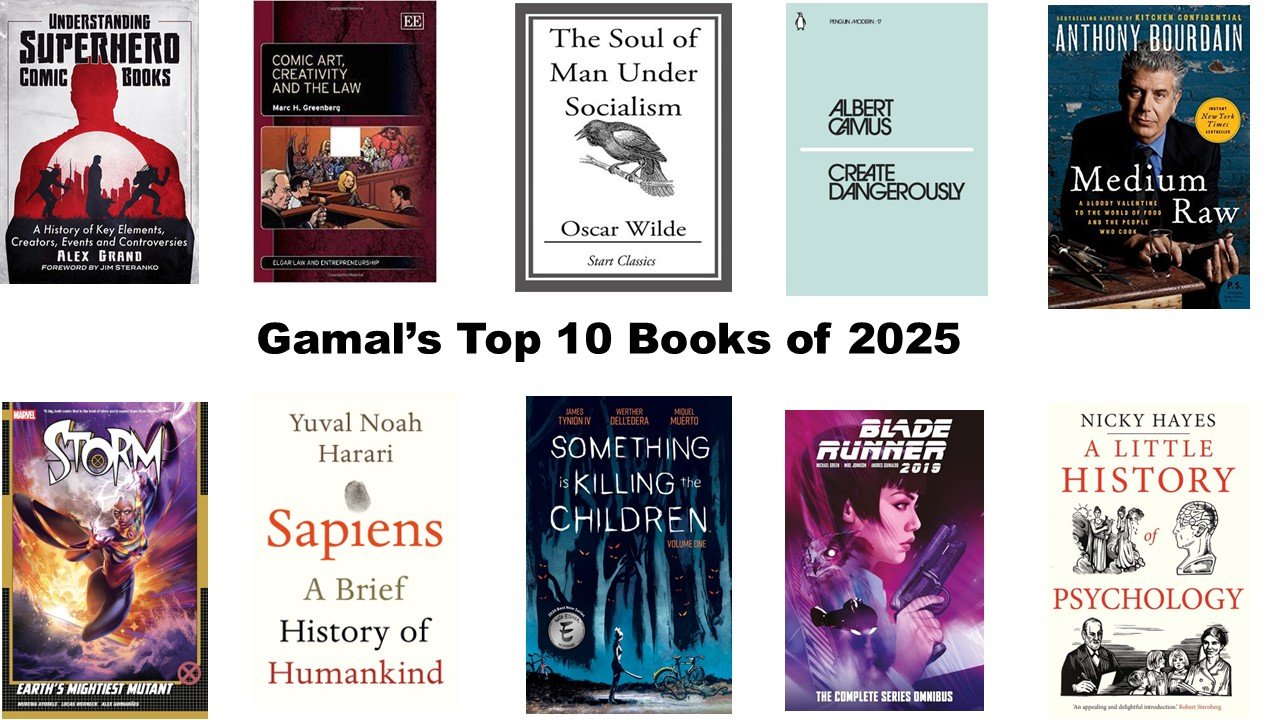
I read ninety books this year in a variety of formats, genres, and from different time periods.
These are the ten best in order of preference.
What was your favorite book of the year?
10. Understanding Superhero Comics by Alex Grand (2023 print)
9. Comic Art, Creativity, and the Law by Marc Greenberg (2014 print)
8. The Soul of Man Under Socialism by Oscar Wilde (2004 audio)
7. Create Dangerously by Albert Camus (2018 print)
6. Medium Raw by Anthony Bourdain (2010 audio)
5. Storm Vol. 1 by Murewa Ayodele and Lucas Wereck (2024 digital)
4. Sapiens by Yuval Noah Harari (2014 audio)
3. Something is Killing the Children Vol. 1 by James Tynion IV and Werther Dell’Edera (2020 print)
2. Blade Runner 2019 Omnibus by Michael Green and Mike Johnson (2025 print)
1. A Little History of Psychology by Nicky Hayes (2024 audio)
Have fun with your comic and enjoy 2026.
Gamal
If you would like to protect the legal rights to your comic or your professional comic book career, my firm is currently accepting both short-term and long-term clients. Please contact me to schedule a free consultation.
PLEASE NOTE: THIS BLOG POST IS NOT A SUBSTITUTE FOR LEGAL ADVICE. IF YOU HAVE A CONTENT, LICENSING, OR INTELLECTUAL PROPERTY ISSUE, DISCUSS IT WITH YOUR LEGAL ADVISOR OR CONTACT C3 FOR A FREE CONSULTATION.